
Every year, computer science researchers look for the right stage to present their ideas, test their assumptions, and meet collaborators. In 2026, the stakes feel even higher as AI, systems, and security research move faster than ever before.
If you are wondering where to focus, events like IEEE INFOCOM 2026 and the 111th Global Conference on Information Technology and Computer Science are already drawing attention. These gatherings reflect the broader landscape of top computer science conferences 2026 and show where serious research conversations are happening.
Choosing the right venue can shape your visibility, collaborations, and even your long-term career path. In this guide, we break down what truly matters and how to plan wisely. Continue reading to explore where your research fits best this year.
Top Computer Science Conferences 2026
Explore the most impactful top computer science conferences 2026 designed for innovators, researchers, and tech professionals eager to stay ahead. From AI breakthroughs to cloud computing trends, these events offer unmatched networking, learning, and global exposure opportunities, helping you shape the future of technology.
| Date | Conference Name | Venue |
| April 3-5, 2026 | 111th Global Conference on Information Technology and Computer Science (GCITCS) | New York, USA |
| 18 – 21 May 2026 | IEEE INFOCOM 2026 | Tokyo, Japan |
| June 19-21, 2026 | 74th Global Conference on Information Technology and Computer Science (GCITCS) | Calgary, Canada |
| 29 June – 1 July 2026 | International Conference on Computational Science | Hamburg, Germany |
| July 31- August 2, 2026 | 89th Global Conference on Information Technology and Computer Science (GCITCS) | Singapore City, Singapore |
| July 2 – 7, 2026 | The 64th Annual Meeting of the Association for Computational Linguistics | San Diego, California |
| September 4-6, 2026 | 92nd Global Conference on Information Technology and Computer Science (GCITCS) | Toronto, Canada |
| August 12–14, 2026 | USENIX Security Symposium 2026 | Baltimore, MD, USA |
| 4-8 October, 2026 | International Conference on Medical Image Computing and Computer Assisted Intervention | Abu Dhabi, UAE |
| November 2–5, 2026 | ACM Symposium on User Interface Software and Technology (UIST) | Detroit, MI USA |
Computer science research moves fast, and conferences remain the best place to test ideas, meet peers, and see what is forming the field. Below is the major 2026 events across systems, AI, security, HCI, and computational science. Explore the details and plan your submissions early.
111th Global Conference on Information Technology and Computer Science (GCITCS)

- Date: April 3 to 5, 2026
- Venue: New York, USA
The 111th Global Conference on Information Technology and Computer Science brings together academics, industry professionals, and doctoral researchers working across core computing domains. It serves as a platform for presenting applied and theoretical work in IT, software systems, and data technologies. Held in New York, USA, it connects researchers looking for upcoming international conferences to share findings, receive feedback, and build collaborations across institutions.
IEEE INFOCOM 2026
- Date: 18 to 21 May 2026
- Venue: Tokyo, Japan
IEEE INFOCOM 2026 in Tokyo, Japan, focuses on computer communications and networking research at scale. The conference is known for rigorous peer review and strong technical sessions on network architecture, distributed systems, and performance analysis. Researchers attend to present foundational and applied networking work, discuss real-life deployment challenges, and engage with both academic and industry experts shaping future internet infrastructure.
74th Global Conference on Information Technology and Computer Science (GCITCS)
- Date: June 19 to 21, 2026
- Venue: Calgary, Canada
The 74th GCITCS provides a multidisciplinary forum covering software engineering, artificial intelligence, cybersecurity, and information systems. Participants typically include faculty members, postgraduate researchers, and technology practitioners. Taking place in Calgary, Canada, the conference supports paper presentations, poster sessions, and structured discussions that encourage feedback and collaboration across institutions working on practical and research-driven computing problems.
International Conference on Computational Science
- Date: 29 June to 1 July 2026
- Venue: Hamburg, Germany
This International Conference on Computational Science focuses on modeling, simulation, and high-performance computing applications. Researchers present work that applies computational methods to science, engineering, and data-intensive problems. Hosted in Hamburg, Germany, this event brings together experts in numerical methods, parallel computing, and data analytics who aim to solve complex practical challenges through advanced computational techniques.
89th Global Conference on Information Technology and Computer Science (GCITCS)
- Date: July 31 to August 2, 2026
- Venue: Singapore City, Singapore
The 89th GCITCS gathers researchers exploring current developments in information technology and computer science. Topics often include machine learning applications, cloud systems, software design, and data management strategies. Set in Singapore City, Singapore, the conference provides presentation slots for emerging researchers and opportunities for structured dialogue with peers working on applied and theoretical computing research.
The 64th Annual Meeting of the Association for Computational Linguistics
- Date: July 2 to 7, 2026
- Venue: San Diego, California
Recognized as a leading venue for natural language processing research, the 64th Annual Meeting of the Association for Computational Linguistics features peer-reviewed papers on language models, machine translation, speech processing, and computational semantics. Researchers gather in San Diego, California, to share reproducible results, attend tutorials, and discuss responsible AI development in language technologies used across academia and industry.
92nd Global Conference on Information Technology and Computer Science (GCITCS)
- Date: September 4 to 6, 2026
- Venue: Toronto, Canada
The 92nd GCITCS provides a space for researchers to present work in computing theory, information systems, and emerging digital technologies. The program typically includes technical paper sessions and networking opportunities for early-career scholars. Held in Toronto, Canada, it supports interdisciplinary discussion and encourages collaboration among participants exploring both foundational research and practical IT implementations.
USENIX Security Symposium 2026
- Date: August 12 to 14, 2026
- Venue: Baltimore, MD, USA
USENIX Security Symposium 2026 is a major conference in cybersecurity research. It highlights work on system security, cryptography applications, privacy technologies, and vulnerability analysis. Researchers meet in Baltimore, MD, USA, to present carefully evaluated studies, discuss defensive strategies, and examine new attack models. The event is known for detailed technical sessions and strong engagement between academia and industry security teams.
International Conference on Medical Image Computing and Computer Assisted Intervention
- Date: 4 to 8 October, 2026
- Venue: Abu Dhabi, UAE
The International Conference on Medical Image Computing and Computer-Assisted Intervention focuses on imaging, computer vision, and AI-driven healthcare systems. It attracts researchers developing algorithms for diagnosis, surgical planning, and clinical decision support. Taking place in Abu Dhabi, UAE, the conference combines technical presentations with workshops that bridge computational research and practical medical applications.
ACM Symposium on User Interface Software and Technology (UIST)
- Date: November 2 to 5, 2026
- Venue: Detroit, MI, USA
ACM Symposium on User Interface Software and Technology explores advances in human-computer interaction and interface engineering. It showcases research on interactive systems, input devices, augmented environments, and user-centered design. In Detroit, MI, USA, researchers present prototypes, technical papers, and live demonstrations that examine how computing systems can be made more intuitive and responsive to real user needs.
These conferences represent a range of computing disciplines from networking and security to AI and human-computer interaction. Review submission deadlines carefully and prepare early to improve acceptance chances and make the most of your 2026 conference plans.
The Role of Peer Review in Advancing Computing Innovation?
Peer review is the reality check that turns promising ideas into usable science. It decides what gets trusted, what gets questioned, and what needs another round of work. Use this section as a practical lens for writing and revising papers for 2026. Start applying these checks before your next submission.
How Peer Review Filters and Improves Research Quality
What reviewers try to confirm early
- The problem is specific, not vague or broad.
- The contribution is identifiable in one sentence.
- The evaluation actually tests the claim.
What triggers doubt fast
- Missing setup details, unclear data, or hidden assumptions.
- Baselines that feel outdated or cherry-picked.
- Results that look strong but cannot be reproduced from the description.
Why Top Tier Venues Maintain Strict Acceptance Standards
Why “good” still gets rejected
- Program space is limited, so reviewers pick work with clear downstream value.
- Novelty is judged relative to recent literature, not older classics.
- Papers are compared against other submissions, not only against a minimum bar.
Signals of an accept-level submission
- One main idea executed deeply, not five ideas done lightly.
- A clear gap in prior work, backed by citations and positioning.
- Evidence that the method is reusable, not a one-off demo.
The Impact of Reviewer Feedback on Refining Technical Work
Most useful reviews are specific. They ask for stronger baselines, deeper error analysis, clearer threat models, or better justification for design choices. A strong rebuttal does not argue emotionally; it answers with evidence and concrete edits. Many papers improve by tightening scope, removing side claims, and adding one decisive experiment that resolves the biggest reviewer doubt.
Real Examples from Systems, AI, and Security Papers
Systems reviewers often demand tail latency results, failure scenarios, and cost tradeoffs, not just average throughput. AI reviewers commonly ask for ablations, sensitivity checks, and evidence against data leakage or shortcuts. Security reviewers press for a precise threat model, reproducible evaluation, and clear boundaries of what the attack or defense does not cover.
Peer review can feel strict, but it creates a shared standard for trust. If you write for reviewer priorities and treat feedback as a design spec, your work becomes clearer, harder to dismiss, and easier for others to build on.
Emerging Research Themes Dominating the Computer Science Landscape
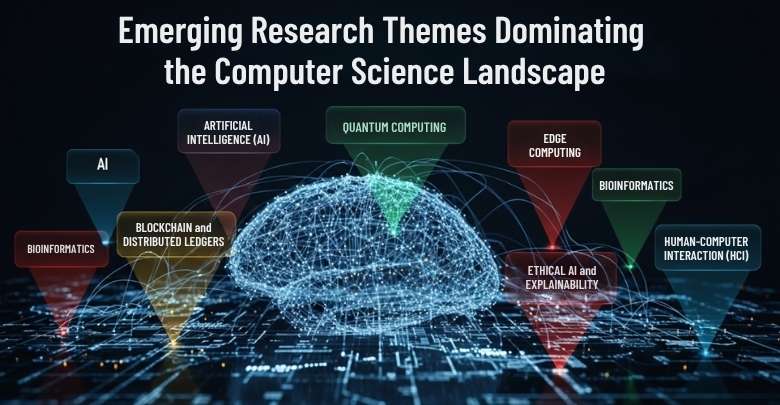
Computer science in 2026 is not moving in one direction. It is expanding across intelligence, infrastructure, security, and real-world integration. If you look at accepted papers and keynote themes this year, a few clear research currents stand out.
Artificial Intelligence and Large Language Models
AI research in 2026 is shifting from scale to responsibility and efficiency. Large language models are being evaluated on:
- Reliability and hallucination control
- Domain adaptation without massive retraining
- Energy efficiency and cost reduction
- Alignment, safety, and evaluation benchmarks
Major events this year show a strong interest in foundation models that are smaller, specialized, and easier to deploy rather than simply larger.
Cybersecurity and Privacy Engineering
Security research is increasingly proactive instead of reactive. In 2026, attention is focused on:
- Secure AI systems and model robustness
- Privacy-preserving machine learning
- Supply chain security in cloud infrastructure
- Real-life exploit analysis and defense automation
Across leading venues this year, you can see deeper threat modeling, reproducibility requirements, and stronger links between academic findings and deployable security tools.
Distributed Systems and Cloud Computing
The cloud is no longer just about scalability. Research in 2026 targets efficiency, resilience, and sustainability.
Common directions include:
- Serverless optimization and cost-aware scheduling
- Edge computing for latency-sensitive applications
- Observability and debugging in large-scale systems
- Carbon-aware workload placement
Systems conferences this year highlight practical deployments, production benchmarks, and measurable infrastructure improvements.
Human Centered Computing
There is a visible shift toward designing systems around real users rather than abstract models.
Key focus areas include:
- Trust in AI systems
- Explainability and transparency
- Accessibility and inclusive design
- Interaction design for mixed reality environments
Work presented this year increasingly combines technical performance metrics with user studies and behavioral evaluation.
Interdisciplinary Computing Across Domains
Some of the most active research in 2026 sits at the intersection of computing and other fields.
You can see strong momentum in:
- AI-assisted healthcare diagnostics
- Robotics for logistics and assisted living
- Climate modeling and sustainability analytics
- Smart infrastructure and urban systems
Major events this year reflect this trend through joint workshops, domain-specific tracks, and industry partnerships that connect computing research to applied challenges.
Across 2026, innovation is concentrated where technical depth meets real-world complexity. Researchers who align their work with these active themes are more likely to find both visibility and long-term impact.
Preparing Your Work for Competitive Academic Platforms
Strong ideas alone are not enough in competitive venues. Presentation, clarity, and evidence determine outcomes. Treat submission as a strategy, not a deadline task. Start refining your paper early.
Structuring a Strong Research Paper
A competitive paper follows a logical narrative. Clearly define the problem, explain why it matters, position it against prior work, and present a focused contribution. Each section should answer a reviewer’s question. Avoid scattered claims. One strong central idea developed thoroughly is more persuasive than multiple loosely connected contributions.
Reproducibility and Open Data Expectations
Top venues increasingly expect transparency. Describe datasets, experimental setups, hyperparameters, and implementation details clearly. When possible, share code or artifacts. Reproducibility signals confidence in your results and reduces reviewer skepticism. Papers that hide critical details often struggle, even when results appear impressive.
Clear Problem Definition and Evaluation Metrics
Ambiguous framing weakens technical work. Define assumptions, constraints, and objectives precisely. Select evaluation metrics that directly measure your stated claim. If your contribution improves robustness, show robustness. If it improves efficiency, report realistic cost or performance benchmarks. Misaligned metrics quickly reduce credibility.
Ethical Considerations and Responsible AI
Ethical reflection is no longer optional, especially in AI-related research. Address data bias, privacy implications, and potential misuse. Include limitations openly. Reviewers value transparency about risks and boundaries. Responsible framing strengthens trust and signals maturity in handling real-life impact.
Practical Submission Strategy
Read several recently accepted papers from your target venue to understand tone, depth, and structure. Study acceptance rates to gauge competitiveness. Track submission and rebuttal deadlines carefully. Rushed formatting, missing appendices, or last-minute uploads often undermine otherwise solid research.
Preparation is strategic work. When structure, evidence, and ethics align, your research stands a stronger chance of surviving rigorous review and earning serious attention.
Building Meaningful Collaborations Within the Computing Community
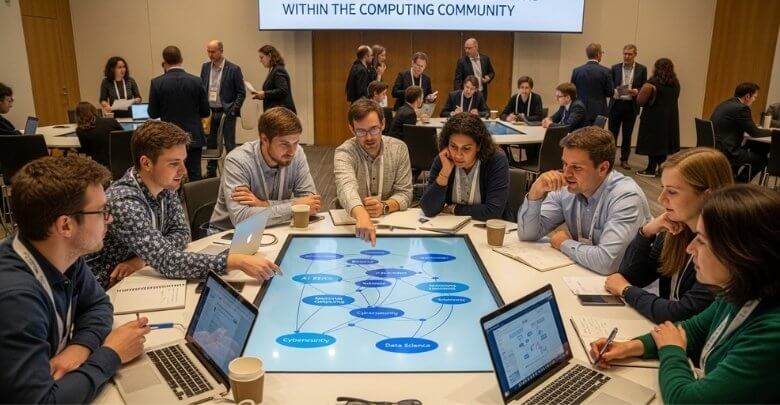
Behind every strong research paper, there is often a strong network. Collaboration deepens ideas, exposes blind spots, and accelerates progress. In 2026, impactful computing research is rarely built in isolation. It grows through shared expertise, open dialogue, and sustained professional relationships.
Why Collaboration Improves Research Depth
Working with others challenges assumptions and strengthens technical rigor. A systems researcher may improve scalability analysis with help from a performance expert. An AI researcher may refine evaluation design through statistical input. Diverse perspectives reduce narrow thinking and lead to solutions that are more robust and broadly applicable.
- Academia and Industry Partnerships: Access real datasets, production systems, and deployment constraints that labs may not have, while companies gain novel methods, research depth, and validation paths for practical adoption.
- Cross-Institution Research Teams: Combine complementary strengths across universities, such as theory, implementation, and evaluation, to produce stronger results, wider visibility, and better alignment for large grants and shared publications.
- Doctoral Consortia and Specialized Workshops: Provide structured feedback from senior researchers and create small, focused spaces where early ideas mature, collaborations start naturally, and researchers find peers with overlapping technical interests.
- Networking as the Starting Point for Joint Projects: Conversations at posters, sessions, and social events often spark joint work, leading to shared datasets, co-authored experiments, and follow-up plans that turn introductions into real research partnerships.
Strong research communities are built on participation, not just publication. When researchers invest in relationships as much as results, they create networks that support both immediate projects and long-term academic growth.
The Link Between Research Quality and Global Recognition
Publishing a paper is not the end goal. The real value appears in how that work travels, gets cited, and influences decisions beyond its original venue. Strong research builds visibility over time. Focus on credibility, not just acceptance.
Citation Impact as a Signal of Influence
Citations reflect whether other researchers build on your work. High-quality papers tend to be cited because they define problems clearly, provide usable methods, or set benchmarks. Consistent citation growth signals relevance and reliability, which gradually strengthen both individual and institutional academic standing.
Institutional Rankings and Research Output
Universities are often evaluated based on research impact, publication quality, and citation metrics. Publishing in respected venues contributes directly to departmental rankings and global perception. When faculty consistently publish influential work, it enhances the institution’s academic profile and attracts stronger students and collaborators.
Career Mobility and Grant Opportunities
Hiring committees and funding agencies examine publication records closely. A consistent track record in respected venues suggests technical depth and reliability. Strong research profiles improve mobility between institutions and increase competitiveness for grants, since reviewers trust applicants with demonstrated research impact.
Invitations to Speak, Review, and Lead
Researchers with credible publication histories are often invited to deliver talks, serve as reviewers, or join program committees. These roles further increase visibility and professional influence. Over time, such recognition shifts a researcher from participant to contributor within the broader computing community.
Long-term credibility is built through consistency. Repeated publication in respected venues creates a research identity that extends far beyond a single paper or presentation.
The Importance of Research Communities in Long-Term Career Growth
A strong publication record opens doors, but long-term growth comes from active participation. Research communities shape reputations, create leadership opportunities, and sustain careers beyond individual papers. Staying involved turns short-term visibility into lasting professional presence.

Staying Active in Professional Societies
Membership in professional societies keeps you connected to evolving standards, policy discussions, and emerging research directions. Regular participation in special interest groups, panels, and working groups builds familiarity within the community. Over time, this steady presence strengthens professional credibility beyond publication metrics alone.
Serving as Reviewer or Committee Member
Reviewing papers sharpens critical thinking and exposes you to innovative work before publication. Serving on program committees signals trust from peers and demonstrates subject expertise. These roles gradually position you as a gatekeeper of quality rather than only a contributor seeking acceptance.
Mentoring and Increasing Visibility
Guiding students, junior researchers, or early collaborators builds influence organically. Mentorship extends your intellectual footprint and strengthens your research network. Visibility also grows through invited talks, panel participation, and workshop leadership, reinforcing your role as an engaged and dependable community member.
Transitioning from Participant to Contributor
Early career researchers often attend events to present their work. Long-term growth comes when you help shape agendas, organize tracks, or influence research directions. Contributing to decision-making spaces signals maturity and leadership, marking the shift from attendee to recognized community contributor.
Sustained careers are built through consistent engagement. When researchers invest in communities, not just publications, they create a professional foundation that supports influence, stability, and continued growth over decades.
Frequently Asked Questions
After exploring research quality, collaboration, and long-term growth, you might still have practical questions in mind. Here are clear, honest answers to things many researchers quietly wonder about.
How Early Should I Start Preparing For A Conference Submission?
You should ideally begin preparing three to six months before submission. This gives you time to refine experiments, improve writing, and get peer feedback. Last-minute drafting usually weakens structure and evaluation quality.
How Do I Know If My Research Topic Is Competitive Enough?
Check recent accepted papers from your target venue. Compare your contribution, depth, and evaluation strength with theirs. If your work clearly adds something new and measurable, it likely has competitive potential.
Is It Better To Submit to a Top-Tier or Mid-Tier Venue First?
It depends on your research maturity and timeline. If your results are strong and well validated, aim high. If the work needs refinement or feedback, a focused venue may be more strategic.
How Important Is Networking For Early Career Researchers?
Networking matters more than many expect. It helps you understand trends, find collaborators, and gain informal feedback. Strong connections often lead to joint projects and future opportunities.
What Makes A Rebuttal Effective During Peer Review?
A strong rebuttal is calm, direct, and evidence-based. Address reviewer concerns clearly without becoming defensive. Show specific changes you will make rather than simply arguing your original position.
Can Industry Professionals Benefit From Academic Conferences?
Yes, especially in areas like AI, systems, and security. Conferences provide exposure to emerging research before it becomes mainstream. They also create opportunities to collaborate with academic teams.
How Do I Build A Recognizable Research Profile Over Time?
Consistency is key. Focus on a clear research direction and publish steadily. Over time, your name becomes associated with specific problems or methods, strengthening recognition and trust within the community.
Concluding Words
The journey through the top computer science conferences 2026 is more than a calendar review. It is about understanding quality, impact, and the people behind the research. Conferences shape ideas long before they shape resumes.
From peer review standards to research themes and collaboration opportunities, every section connects to one goal: building meaningful academic progress. Strong platforms reward clarity, depth, and responsibility.
As you plan ahead, think beyond submission deadlines. Focus on preparation, community engagement, and long-term credibility. The right decisions today can influence your research path for years to come.