Conferences give researchers and professionals a chance to share their work, learn new ideas, and meet others. When you attend one, you may hear the terms “conference paper” and “conference proceedings.” Though similar, they are not exactly the same and serve different purposes.
To understand conference proceedings vs conference paper, know that a conference paper is a single research submission by an author, either presented or accepted. Conference proceedings are the full collection of these papers, published together after the event. They act as a permanent record of what was shared at the conference.
Keep reading to learn how each one works in academic settings. Discover why both terms matter in research and publishing. Find out how they affect your academic profile and citations.
Quick Summary Table (Conference Proceedings VS Conference Paper)
| Aspect | Conference Proceedings | Conference Paper |
| Definition | A published collection of all papers from a conference. | A single research paper submitted or presented at a conference. |
| Peer Review | Usually peer-reviewed as a collection. | Individually reviewed before acceptance. |
| Publication Status | Final published volume. | Becomes published once included in proceedings. |
| Indexing | Often indexed in Scopus, IEEE Xplore, ACM DL. | Indexed only if included in proceedings. |
| Academic Value | Provides event-wide record and broad visibility. | Shows individual contribution and research findings. |
| Citation Impact | Cited as an entire volume or series. | Cited individually by authors and researchers. |
| Accessibility & Longevity | Stored in digital libraries for long-term access. | Long-lasting only if archived in proceedings. |
What is a Conference Paper?
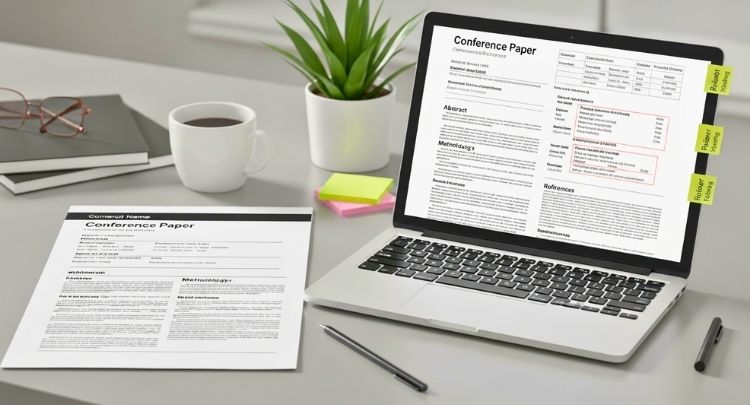
A conference paper is a research work submitted to an academic or professional conference for review, presentation, and possible publication. It communicates new findings or ongoing studies to a targeted audience. Researchers often align submissions with upcoming conferences in Canada to gain feedback, expand professional networks, and showcase innovations prior to journal publication.
Purpose and Role in the Research Lifecycle
Conference papers play an important role in early-stage knowledge sharing. They allow researchers to:
- Present new or emerging results
- Receive feedback from experts
- Improve work before journal submission
- Build visibility within their field
- Contribute to collaborative discussions and workshops
Many researchers use conference papers as a stepping stone toward full journal articles.
Types of Conference Papers
Different conferences accept various submission formats, depending on their goals and review processes. Common types include:
Full Paper
A complete study (usually 6–12 pages) presenting mature research with detailed methods, results, and discussion. These papers often appear in conference proceedings and are indexed in major databases.
Short Paper
A concise report (typically 2–6 pages) presenting early findings, pilot results, or focused contributions. Short papers may be published or presented as posters or brief talks.
Extended Abstract
A structured summary (1–3 pages) outlining research motivation, approach, and key findings. Often used in humanities, social sciences, and some STEM events that prioritize discussion.
Poster
A visually presented summary of research. Posters are ideal for work in progress, exploratory ideas, or small-scale studies.
Work-in-Progress (WIP) Paper
A developing project showing preliminary data or experimental direction. WIP papers encourage community feedback before the study becomes a full paper.
Peer-Review Models
Conference papers undergo different review processes depending on discipline and organization.
Double-Blind Review (Common in IEEE, ACM, Engineering, Computer Science)
Both authors and reviewers remain anonymous to ensure fairness.Used by: IEEE conferences, ACM SIGCHI, SIGCOMM, ICML, NeurIPS (for papers).
Abstract-Only Review (Humanities, Social Sciences, Education)
Committees review abstracts rather than full manuscripts. Full papers may not be required.
Medical Abstract Submissions
Medical and clinical conferences often accept abstract-only submissions, selecting top abstracts for oral or poster presentation.
What Happens After Acceptance?
Once accepted, authors may need to follow specific steps:
Presentation Formats
- Oral Presentation (10–20 minutes)
- Poster Session
- Demonstration / Prototype Demo
- Lightning Talk or WIP Talk
Submission Requirements
Some conferences require a full camera-ready paper, while others accept only abstracts or posters.
Publication Decision
Not all accepted presentations are automatically included in conference proceedings—this varies by event.
Does a Conference Paper Count as a Publication?
It depends on the field, institution, and whether the paper appears in official indexed proceedings.
A conference paper is typically considered a publication when:
- It is included in proceedings
- It receives an ISBN/ISSN
- It is indexed in databases like IEEE Xplore, ACM Digital Library, Scopus, or SpringerLink
In fields like computer science and engineering, conference papers often carry significant academic weight. In humanities and medical fields, conferences may serve more for discussion than formal publication.
What are Conference Proceedings?
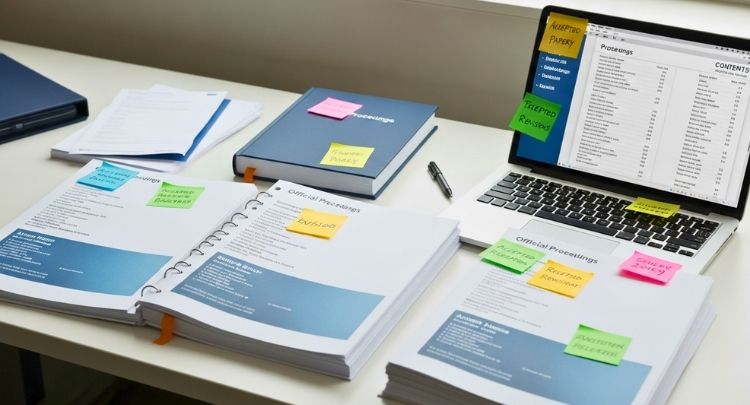
Conference proceedings are the official published collection of papers, abstracts, or research outputs presented at a conference. They serve as a permanent academic record of the event and help disseminate new findings to a global audience. Proceedings often include peer-reviewed work and are distributed through digital libraries, ensuring long-term scholarly access.
Purpose of Proceedings
Archival Record of the Conference
Proceedings preserve the scientific contributions shared at the event, allowing researchers to reference, cite, and build upon the presented work. They also motivate scholars to participate in academic conferences, as formal documentation enhances visibility, supports career advancement, and ensures that valuable insights reach a wider academic and professional audience.
ISBN/ISSN Assignment
Proceedings typically receive an ISBN (book identifier) or ISSN (serial identifier), making them formally recognized publications in academic databases and library systems.
Digital Publication Norms
Most proceedings today are published online, offering:
- Searchable PDF volumes
- DOI-assigned papers
- Long-term digital preservation
- Open-access or restricted-access models
Digital-first publication ensures quick global visibility and indexing.
Who Publishes Proceedings?
Conference proceedings can be published by different types of organizations based on the conference’s scale, field, and partnerships.
Academic Publishers
Renowned publishers release high-quality, peer-reviewed proceedings, often with indexing.
Examples:
- Springer Lecture Notes in Computer Science (LNCS)
- IEEE Xplore
- ACM International Conference Proceedings Series (ICPS)
University Presses
Many academic institutions publish proceedings for conferences they host, especially in humanities and social sciences.
Society Publishers
Professional associations like APA, AOM, and ASME publish proceedings linked to their annual meetings or symposia.
Independent Conferences
Smaller or niche conferences publish their own proceedings—sometimes digitally, sometimes through local publishers.
Types of Proceedings
Full-Paper Proceedings
Contain complete research papers that have undergone peer review. Common in computer science, engineering, and sciences.
Abstract-Only Proceedings
Include extended abstracts or summaries instead of full manuscripts. Frequently used in medicine, humanities, and social sciences.
Supplementary Volumes
Additional booklets for workshops, posters, or companion events. Often published separately from the main proceedings.
Digital-Only Proceedings
Published exclusively online, often with DOIs, ensuring immediate visibility and lower production costs.
Proceedings Formats
PDF Volume
A single compiled PDF containing all conference papers arranged by session or theme.
Paper-by-Paper Format With DOIs
Each paper appears as an individual download with a unique DOI and metadata, common in IEEE, ACM, Scopus-indexed series, and online libraries.
Indexed Series
Proceedings published in recurring series are indexed in major databases such as:
- Scopus
- Web of Science
- IEEE Xplore
- ACM Digital Library
- SpringerLink
Indexed proceedings improve citation potential and academic value.
Key Differences: Conference Paper Vs. Proceedings (Deep Academic Breakdown)
Conference papers and conference proceedings are closely related but serve different functions in scholarly communication. A conference paper is an individual research work authored and presented by a researcher, while proceedings represent the published collection of all accepted contributions from an event. Below is a deeper academic breakdown of how they differ:
The Purpose
Conference Paper:
Aims to share new research findings, gather feedback, and introduce ideas at an early stage of the research lifecycle. It represents a single author’s or team’s contribution to the conference.
Conference Proceedings:
They serve as the archival record of the entire conference, preserving its intellectual contributions over time. Because they validate and formalize research outputs, proceedings are essential for publication, enabling scholars to disseminate findings, receive citations, and ensure their work remains accessible in a permanent, citable academic format.
Peer Review Depth
Conference Paper:
Often undergoes rigorous peer review, especially in fields like computer science, engineering, and AI. Many conferences use double-blind review and apply strict evaluation criteria (originality, methodology, significance).
Conference Proceedings:
Review depth varies.
- Some proceedings include fully peer-reviewed papers.
- Others include minimally reviewed or abstract-only submissions, selected editorially for presentation.
Editorial decisions often dictate what is published in the final volume.
Publication Status
Conference Paper:
A paper becomes presented once accepted for conference sessions. It only becomes published if included in the official proceedings or an indexed series.
Conference Proceedings:
Represent the final published output, assigned an ISBN/ISSN, DOIs, and metadata. Proceedings are submitted to libraries and indexing databases, making the research part of the global scholarly record.
Indexing & Discoverability
Conference Paper:
Discoverability depends entirely on where it is published. If included in proceedings, it may be indexed in:
- IEEE Xplore
- ACM Digital Library
- SpringerLink
- Scopus
- Web of Science
If not included, a conference paper may remain only as a presentation file or poster with limited visibility.
Conference Proceedings:
Typically indexed as a full volume or series, making all included papers discoverable through academic databases. Indexed proceedings carry greater academic visibility and long-term accessibility.
Citation Behavior
Conference Paper:
Cited individually using the paper’s title, authors, and DOI (if available). Citation impact depends on indexing, readership, and visibility.
Conference Proceedings:
Cited as a volume or series, often associated with a publisher (e.g., IEEE, Springer LNCS, ACM ICPS). Proceeding’s citations reflect the scholarly output of the event rather than an individual study.
Editorial Oversight
Conference Paper:
Reviewed by program committees or technical reviewers. Oversight focuses on scientific accuracy, originality, clarity, and fit with conference themes.
Conference Proceedings:
Managed by proceedings editors, publishers, or editorial boards. They oversee copyediting, formatting, metadata assignment, indexing submissions, and publication deadlines.
Ethical Requirements (COPE Standards)
Conference Paper:
Authors must follow ethical standards for originality, authorship, data reporting, and conflict-of-interest disclosure. Plagiarism checks and integrity policies are common.
Conference Proceedings:
Publishers must ensure compliance with COPE guidelines, including ethical editing, proper corrections or retractions, metadata accuracy, and avoidance of duplicate publication. Proceedings editors also verify that all papers meet academic integrity criteria.
APA Citation Examples: Conference Paper vs Conference Proceedings
Correct citation depends on whether the paper was only presented or formally published in conference proceedings. Below are clear APA-style examples to avoid common citation mistakes.
Unpublished conference paper (presentation only):
Author, A. A. (Year, Month). Title of paper. Paper presented at the Conference Name, City, Country.
Published conference proceeding paper:
Author, A. A. (Year). Title of paper. In E. E. Editor (Ed.), Proceedings of the Conference Name (pp. xx–xx). Publisher. https://doi.org/xxxxx
Important note:
Only papers included in official proceedings receive a publisher, page range, and DOI. Presentations without proceedings should never be cited as published works.
How to Check the Quality and Value of a Conference Publication? (Indexing, Academic Recognition & Credibility)
Not all conference publications carry the same academic weight. Some are highly respected, widely indexed, and stable over time; others are barely visible or even considered “predatory.” Here’s how to quickly judge the quality and value of a conference paper or proceedings.
Why Indexing Matters
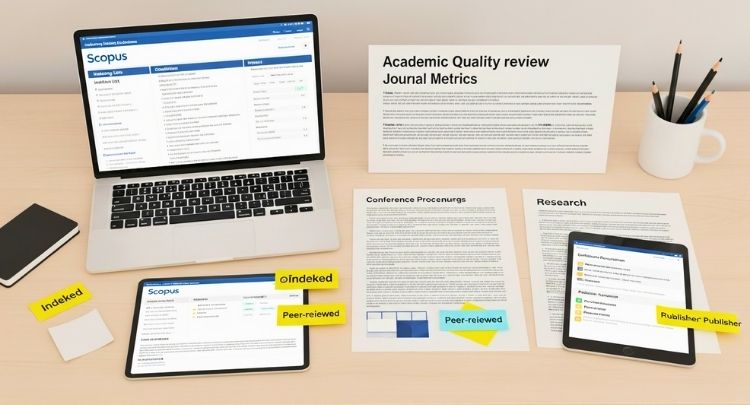
Indexing tells you whether a conference publication is part of the recognized scholarly record. When proceedings are indexed, they:
- Become searchable in academic databases
- Are easier to cite and track
- Count more strongly for CVs, tenure, and grant applications
Universities and funding bodies often look for publications in Scopus, Web of Science, or established publisher libraries (IEEE, ACM, Springer, etc.), because these platforms apply minimum quality and editorial standards.
Main Indexers
Some indexers are more influential than others. The big ones that matter most for conference proceedings include:
- Scopus: Large multidisciplinary database covering many conference series (Springer LNCS, IEEE, ACM, etc.).
- Web of Science-Conference Proceedings Citation Index (CPCI): Tracks selected, higher-impact conference series.
- IEEE Xplore: Core library for engineering, electronics, and computer science conference proceedings.
- ACM Digital Library: Key library for computing and information science conferences.
- DBLP: Highly used bibliography for computer science (tracks conference series and papers).
- Google Scholar: Broad discovery tool; indexes many conferences, but with less strict quality control.
A conference that appears in IEEE Xplore or ACM DL and is also indexed in Scopus or Web of Science (CPCI) will usually carry solid academic weight in technical fields.
How To Check If Proceedings are Indexed (Step-By-Step)
Use this quick checklist before you submit or list a conference on your CV:
-
Check the Conference Website
-
-
- Look for claims like “indexed in Scopus / Web of Science / IEEE Xplore / ACM DL.”
- Verify the exact series name (e.g., “Springer Lecture Notes in Computer Science”).
-
-
Search the Publisher Platform
-
-
- Go to IEEE Xplore, ACM DL, SpringerLink, or the stated publisher.
- Search by conference name, year, and acronym.
- Confirm that previous years’ proceedings are actually available.
-
-
Search Scopus or Web of Science
-
-
- Use the “Sources” or “Master Journal List” tools.
- Search by conference series title (not just the acronym).
- Check whether recent years are still indexed (some series get dropped).
-
-
Look Up The Series In DBLP (For CS Conferences)
-
-
- Go to DBLP and search the conference acronym.
- Confirm its series history, publisher, and continuity.
-
-
Check Google Scholar As A Backup
-
-
- Search for “Conference Name + year + proceedings.”
- See whether papers appear with proper citations and publisher metadata.
-
-
Watch For Red Flags
-
- No clear publisher.
- Vague or misleading indexing claims.
- No past volumes visible anywhere reputable.
If you cannot find the proceedings in any of these places, treat the conference as low-visibility or low-credibility.
Impact On Academic CVs & Tenure
The value of a conference publication depends on field, country, and institutional norms:
- Computer Science / Engineering: Top conferences published in IEEE, ACM, or Springer and indexed in Scopus/Web of Science often count almost like journal papers, especially in North America, Europe, and parts of Asia.
- Medicine / Life Sciences: Conference abstracts are useful but usually rank below peer-reviewed journal articles for promotion and grants. They may count as “scientific communications” rather than full publications.
- Humanities / Social Sciences: Conference presentations are important for networking and reputation, but proceedings often have lower weight unless they are part of a well-known series or edited book with a strong publisher.
- Regional Differences: Some countries emphasize quantity (any indexed proceedings help for scoring systems), while others focus on quality (only specific indexers or quartile ranks matter).
As a rule of thumb: indexed, publisher-backed proceedings strengthen your CV more than unindexed, self-published ones.
Warning: How to Spot Predatory Conferences and Fake Proceedings?
Not all conferences or proceedings listed online meet academic publishing standards. Some events operate on a pay-to-publish model, prioritizing fees over peer review, editorial oversight, or indexing quality.
Common warning signs include unclear or false indexing claims, unrealistically fast acceptance decisions, vague review processes, and conference scopes that cover unrelated disciplines in a single event. Legitimate proceedings always show verifiable past volumes, real publishers, and traceable DOIs.
Before submitting your work or paying registration fees, verify previous proceedings in trusted databases, confirm the publisher’s identity, and ensure the conference has a consistent academic record. Taking these checks seriously helps protect your research, reputation, and long-term citation value.
Longevity & Digital Preservation
Quality proceedings are not just indexed; they are also preserved:
- Major publishers and libraries often participate in preservation systems such as LOCKSS (“Lots of Copies Keep Stuff Safe”) and CLOCKSS, which ensure long-term access even if websites change or publishers merge.
- DOIs and permanent URLs help keep links stable over time.
Non-indexed or poorly managed proceedings may:
- Disappear when a website shuts down
- Lose PDFs, links, or metadata
- Become difficult to cite or verify years later
This is why choosing conferences with reputable publishers and stable indexing is crucial: your work remains visible, citable, and trusted in the long term.
Discipline-Specific Differences Between Conference Proceedings and Conference Paper
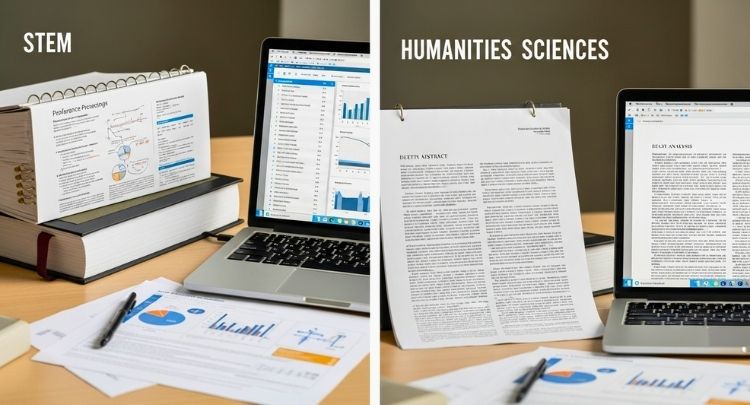
Conference publications carry different levels of value depending on the academic discipline. Some fields treat conference papers as major research outputs, while others see them as early-stage work. The differences below highlight how each discipline views proceedings and conference papers.
Computer Science & AI
In computer science and artificial intelligence, top-tier conferences often rank higher than journals in prestige and citation impact. Proceedings published by IEEE, ACM, NeurIPS, ICML, or CVPR are highly respected and heavily indexed. A conference paper can be considered a major scholarly contribution, sometimes equivalent to a journal article in hiring and promotion decisions.
Engineering
Engineering fields frequently accept conference proceedings as valid, citable publications, especially when published in IEEE or other established technical series. However, journals remain the gold standard in core engineering disciplines like mechanical, civil, and chemical engineering. Conferences are valued for rapid dissemination, while journals offer deeper peer review.
Medicine & Health Sciences
Medical and clinical sciences typically use abstract-only conference submissions, not full papers. Presentations help disseminate early results, but journal articles carry the real academic weight. Proceedings rarely count as peer-reviewed publications, and they usually serve as preliminary communication rather than formal scholarly output.
Social Sciences
In social sciences, proceedings are less common and may hold limited academic value. Conferences primarily function as platforms for discussion, networking, and theory development. Research typically reaches formal publication through peer-reviewed journals or edited book chapters rather than proceedings volumes.
Humanities
Humanities disciplines rarely rely on conference proceedings. Instead, peer-reviewed journal articles, monographs, and edited books dominate scholarly communication. Conference papers are often seen as early drafts, with the expectation that researchers will develop them into full articles or chapters for long-term publication and citation.
Business & Economics
Business and economics use a mixed model. Journals—especially high-impact economics journals—remain the primary measure of academic achievement. However, certain subfields (management, information systems, operations research) value proceedings from reputable conferences like AOM, ICIS, or POMS. The importance of proceedings depends heavily on the conference ranking.
Choosing where to publish depends on your research stage, career needs, and the expectations of your discipline. Use this guide to decide whether a conference paper, proceedings publication, or a journal article best fits your goals.
Choose a Conference Paper When…
- Your research is early-stage and you want to test ideas.
- You need quick feedback from experts before expanding your study.
- You want presentation experience to build visibility and networks.
- You are in fields like computer science, AI, or engineering where conferences carry strong academic value.
- You want to validate your approach or gather comments before journal submission.
Choose Proceedings Publication When…
- The conference provides high-quality, indexed proceedings (IEEE Xplore, ACM DL, Springer LNCS, Scopus, CPCI).
- You want fast dissemination with formal publication status.
- You need a citable output quickly for your CV, grant, or graduation requirements.
- The work is solid but not yet mature enough for a full journal article.
- You work in fields where proceedings are recognized (computer science, engineering, robotics, information systems).
Choose a Journal When…
- Your research is fully developed with complete experiments, analysis, and conclusions.
- You aim for higher impact, stronger peer review, and wider recognition.
- Promotion, tenure, or funding bodies in your field require journal publications.
- You are in disciplines where journals dominate (medicine, social sciences, humanities, business, economics).
- You want a stable, long-term, highly citable record of your work.
Decision Tree: Should I Publish as a Conference Paper, Proceedings, or Journal?
Use this simple text-based decision tree (SEO-friendly and accessible):
“START
├── Is your research complete and mature?
│ ├── YES → Submit to a JOURNAL.
│ └── NO →
│
├── Do you want early feedback or discussion?
│ ├── YES → Submit a CONFERENCE PAPER.
│ └── NO →
│
├── Does the conference offer reputable indexed proceedings?
│ ├── YES → Publish in the PROCEEDINGS.
│ └── NO →
│
├── Do you need a quick, citable publication?
│ ├── YES → Choose PROCEEDINGS.
│ └── NO →
│
└── Are journals required for your field or career?
├── YES → Prepare a JOURNAL SUBMISSION.
└── NO → A CONFERENCE PAPER may be enough.
END”
Converting a Conference Paper into a Journal Article (With Ethical Standards)
Turning a conference paper into a journal article is common, but it must follow strict ethical and publishing standards. Most major publishers allow journal versions of conference work only when the new article offers substantial new content, clearer analysis, and original contributions beyond the proceedings version.
Requirements From Major Publishers
IEEE
IEEE permits journal extensions of conference papers when authors:
- Add significant new material (expanded methods, results, experiments).
- Clearly cite the original conference paper.
- Ensure the journal version passes similarity checks with acceptable overlap.
- Follow COPE guidelines for fair reuse and transparency.
Springer (Including LNCS & Journals)
Springer requires:
- At least 30–50% new content, including expanded theory or validation.
- Clear disclosure that the article extends a conference version.
- Sufficient novelty to justify peer review as a new contribution.
- Proper citation of the proceedings version.
Elsevier (ScienceDirect Journals)
Elsevier allows journal extensions when authors:
- Demonstrate substantial new insights (new datasets, deeper analysis, more experiments).
- Rewrite sections rather than copy-paste text.
- Include a statement such as: “This work extends our conference paper presented at…”.
- Reduce text similarity to avoid self-plagiarism.
Wiley (Author Guidelines)
Wiley expects:
- Major expansion in data, scope, methodology, or interpretation.
- Transparent referencing of the original work.
- Ethical compliance with COPE and journal-specific rules.
- A written explanation (in cover letter) describing what is new.
How to Avoid Self-Plagiarism
Self-plagiarism occurs when authors reuse text, figures, or data from a previous publication without proper acknowledgement. To avoid problems:
- Rewrite the introduction and related work sections with new context.
- Redo or significantly expand analyses, graphs, and experiments.
- Label reused figures clearly and obtain permission if required.
- Use a similarity checker to keep overlap below journal guidelines (often <20%).
- Always cite your conference version.
Typical Expectations for “Significant Extension”
Most journals—including IEEE Transactions, Springer journals, Elsevier journals, and Wiley titles—expect:
- 30–50% new content
- New experiments, datasets, case studies, or proofs
- Expanded discussion, limitations, and future work
- Stronger theoretical grounding or deeper application analysis
- Improved writing, longer word count, clearer structure
- More robust statistical or empirical validation
Simply adding paragraphs or cosmetic changes is not enough.
Citation Requirements for the Original Conference Version
Authors must explicitly cite the earlier paper. A standard citation note may look like:
“An earlier version of this work appeared in the Proceedings of [Conference Name, Year]. This journal article provides substantial extensions including new experiments, expanded analysis, and additional theoretical contributions.”
Many journals also require you to explain these differences in the cover letter to the editor.
Examples of Acceptable Transformations
Here are practical examples of how to ethically extend a conference paper into a journal article:
Adding New Experiments
Conference version: 2 experiments
Journal version: 6 experiments with new datasets and additional metrics
Expanding Theoretical Frameworks
Conference version: Preliminary model introduced
Journal version: Full mathematical proofs, error analysis, or scalability studies
Deepening Analysis
Conference version: Short results discussion
Journal version: Full interpretation, statistical testing, robustness checks
Integrating New Literature
Conference version: Compact related work
Journal version: Updated scholarly review reflecting post-conference research
Enhanced Methodology
Conference version: Early pilot method
Journal version: Improved algorithm, validation pipeline, extended simulations
Broader Impact Discussion
Conference version: Practical demonstration
Journal version: Ethical analysis, limitations, real-world applications
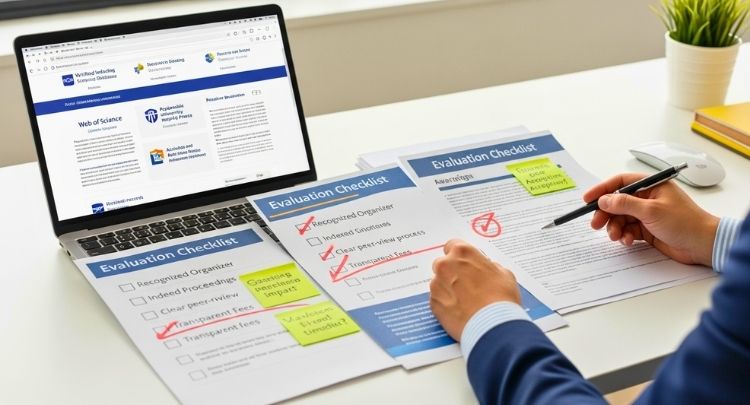
How to Evaluate Conference Quality (Preventing Predatory Conferences)
With the rise of low-quality and predatory conferences, researchers must carefully evaluate events before submitting papers or paying registration fees. High-quality conferences maintain strong peer review, transparent editorial standards, and a verifiable publishing history. Use the guidance below to avoid scams and choose reputable venues for your work.
Red Flags
Watch for the following warning signs, which often indicate a questionable or predatory conference:
Fake Editorial Boards
Predatory events frequently list well-known scholars without their consent or feature nonexistent committee members. Names often lack institutional affiliations or verifiable profiles.
Unrealistic Acceptance Deadlines
Be cautious if the conference promises acceptance within 48–72 hours or allows full-paper submissions just days before the event. Quality conferences require weeks of peer review.
Multi-Topic “Umbrella” Conferences
Events that claim to cover hundreds of unrelated fields—engineering, medicine, AI, education, environment, economics—at the same time and location are usually low quality.
Mass Email Invitations
If you receive generic invitations that don’t reference your research area, it’s likely a spam or predatory event. High-quality conferences rarely cold email large lists of researchers.
Lack of Indexing History
If previous years’ proceedings do not appear in Scopus, Web of Science (CPCI), IEEE Xplore, ACM DL, or SpringerLink, the conference may lack credibility or could be entirely fabricated.
Verification Checklist (Quick Evaluation Guide)
Use this step-by-step checklist before submitting your paper:
Check Past Proceedings
Search previous editions on IEEE Xplore, ACM DL, Springer, or Scopus. A reliable conference has a consistent publishing record.
Verify DOIs
Ensure each paper from earlier conferences has a valid DOI that resolves to a recognized publisher.
Cross-Check Indexing Claims
If the website says “indexed in Scopus” or “indexed in Web of Science,” confirm it through the actual indexing databases. Predatory events often post false logos.
Validate Organizers
Look up the host institution, organizing committee, or society. Reputable conferences are typically run by:
- Universities
- Recognized academic societies
- Established publishing partners (IEEE, ACM, Springer, Elsevier)
Review Peer-Review Process
Legitimate conferences describe their review procedure clearly—double-blind, single-blind, or editorial review—along with expected timelines.
Search Research Forums
Check ResearchGate, Reddit (r/academia), or field-specific mailing lists for community opinions on the conference.
Examples of Reputable Proceedings Series
The following series are widely recognized and trusted across disciplines:
ACM SIGCSE
A top venue for computer science education research, published in the ACM Digital Library with strong peer review and indexing.
IEEE ICASSP
One of the leading conferences in signal processing, published in IEEE Xplore and indexed in Scopus and Web of Science.
Springer Lecture Notes in Computer Science (LNCS)
A long-standing, respected proceedings series covering computer science, AI, and engineering, with consistent indexing and editorial standards.
Frequently Asked Questions about Conference Proceedings VS Conference Paper
Understanding conference publications can be confusing, especially for new researchers. These FAQs address practical concerns about academic value, publication ethics, indexing, and citation rules. Each answer gives you clear, updated guidance to help you make informed decisions in current years and beyond.
Does A Conference Paper Count As A Publication?
A conference paper counts as a publication only if it appears in official conference proceedings or a recognized digital library with a DOI. Merely presenting your work does not qualify as publishing. Academic value varies by field, institution, and whether the proceedings are indexed.
Are Conference Proceedings Peer-Reviewed?
Conference proceedings may be peer-reviewed, but the depth of review varies significantly. Some conferences conduct full double-blind reviews, while others accept papers based on abstracts or editorial screening. Always check the conference’s review policy to understand its rigor and academic credibility.
Should I Publish In Proceedings Or A Journal?
Choose proceedings for rapid dissemination and early-stage research, especially in fast-moving fields like computer science. Choose journals when you need higher academic recognition, deeper peer review, and stronger citation impact. The best choice depends on your goals and disciplinary norms.
How Do I Know If Proceedings Are Indexed?
You can check indexing by searching the proceedings series in Scopus, Web of Science, or the publisher’s website. Reputable conferences clearly list indexing on their call-for-papers page. If past volumes are indexed, future ones typically follow the same pattern.
Can I Publish A Journal Article After A Conference Paper?
Yes. Many journals accept extended versions of conference papers if substantial new content is added—typically 30–50% more analysis, results, or discussion. Always cite the original conference paper to avoid self-plagiarism and comply with publisher ethics requirements.
What Is The Difference Between Abstract-Only And Full-Paper Conferences?
Abstract-only conferences evaluate short summaries and often publish only abstracts, not full papers. Full-paper conferences require complete manuscripts and typically include them in proceedings. This difference affects visibility, indexing, and whether your contribution counts as a formal publication.
Do All Proceedings Have DOIs?
Not all proceedings include DOIs. Major publishers like IEEE, ACM, and Springer assign DOIs to each paper, enhancing discoverability and citation tracking. Smaller or low-budget conferences may skip DOIs, reducing long-term visibility and academic recognition.
Can Proceedings Be Retracted?
Yes. Proceedings can be retracted for reasons such as fake peer review, plagiarism, fraudulent data, or predatory publishing practices. Major publishers periodically remove entire volumes if integrity issues arise, which can affect the credibility of all included papers.
How Do I Cite A Conference Paper vs Proceedings Article?
Conference papers presented but not published are cited using presentation details. Published proceedings papers require publisher information, DOI, page numbers, and editors. Each citation style—APA, MLA, Chicago—has specific rules, so consult the appropriate manual for consistency.
What If My Conference Doesn’t Publish Proceedings?
If no proceedings exist, your work is considered a presentation, not a publication. You may still list it under “Conference Presentations” on your CV. Many authors later expand such work into a journal manuscript or submit it to a conference with proceedings.
Do Proceedings Papers Receive Citations Like Journal Articles?
Proceedings papers do receive citations but typically at lower rates and for shorter periods compared to journal articles. Citation impact varies heavily by discipline, with computer science and engineering valuing proceedings highly, while medicine, humanities, and social sciences emphasize journals.
Can I Submit The Same Paper To Multiple Conferences?
Most conferences prohibit simultaneous or duplicate submissions. Submitting the same paper to multiple venues violates academic ethics and may lead to rejection or blacklisting. Always check the conference’s submission policies and withdraw from one venue before submitting to another.
Bottom Lines
You should take time to fill every part of your application with care because small mistakes can slow your plans and create stress. If you notice an error, act fast, follow the steps for corrections, and give the right papers so the office can update your record.
Clear choices matter in research too, such as when you compare conference proceedings vs conference paper for your work. Wrong details in any process can lead to delays, extra fees, or even a denial. Stay calm, fix the issue early, and keep simple notes so you move forward with confidence and ease.