Last year, a traveler booked flights to Turkey for a short business trip. Everything looked perfect until one question stopped the plan completely. Should the application be for an eVisa or a sticker visa? A quick search brought confusion instead of answers. Different rules, different fees, and different timelines made the decision harder than expected.
This situation is very common. Many people planning a trip to Turkey face the same problem and end up unsure about Turkey eVisa VS Sticker Visa- what are the key differences? A small mistake at this stage can delay travel or even cause visa rejection.
The Turkey eVisa is an online permit for short tourism or business stays, usually up to ninety days, with fast approval and lower cost. A sticker visa is placed inside the passport, needs embassy visits, costs more, takes longer, and supports work, study, or long stays.
This guide breaks everything down in clear points with real examples. You will learn how each visa works, who should apply, how much it costs, how long it takes, and which option fits your travel plan best. By the end, you can choose confidently and prepare your Turkey visa without confusion or delays.
Turkey eVisa VS Sticker Visa- What are the Key Differences?
Travel planning starts with choosing the right visa for Turkey. Many travelers feel confused between eVisa and sticker visa options. Both visas serve different needs, stay lengths, and travel purposes. Read below to understand each option clearly and choose wisely.
| Feature | Turkey eVisa | Turkey Sticker Visa |
| Meaning | Digital travel permission linked to passport | Physical visa sticker placed in passport |
| How You Apply | Online application from anywhere | Apply through embassy or consulate |
| Processing Time | Fast, often within a few days | Slower, may take weeks |
| Cost | Usually lower and budget friendly | Often higher with extra fees |
| Where Visa Is Stored | Electronic record, printable copy | Sticker fixed inside passport |
| Purpose Of Travel | Tourism and short business visits | Study, work, long stays, special reasons |
| Length Of Stay | Up to 90 days within 180 days | Depends on visa type, often longer |
| Convenience | Very easy, no embassy visit | Less convenient, requires paperwork |
Meaning Of Both Visas
These two visas allow entry into Turkey but work differently. The eVisa is a digital travel permit linked to your passport. It is mainly for short visits. The sticker visa is a physical label placed in your passport. It suits longer stays and special travel needs.
How You Apply
Getting a Turkey eVisa is simple and fully online. You fill out a form, upload details, and submit payment from home. The sticker visa follows a slower path. It requires embassy forms, passport submission, and sometimes an interview or appointment.
Processing Time
Time matters when travel dates are close. The eVisa usually arrives fast, often within a few days. In many cases, approval comes even sooner. Sticker visas take longer because embassies review documents carefully. Processing may stretch from several days to weeks.
Cost Difference
Budget planning is easier with a Turkey eVisa. The fee is usually lower and paid online. There are no extra travel or courier costs. Sticker visas often cost more due to embassy fees. Extra charges may apply for services or document handling.
Where The Visa is Stored
A Turkey eVisa is digital and linked to your passport number. You can print it or keep it on your phone. There is no physical mark inside the passport. The sticker visa is a printed label. It is placed directly on a passport page.
Purpose Of Travel

The eVisa works best for short tourism or business visits. It suits meetings, sightseeing, or events with limited stay plans. Sticker visas cover broader needs. They support study, work, residence, or long-term travel reasons that require approval.
Length Of Stay Allowed
Most Turkey eVisas allow stays up to 90 days within 180 days. This suits short visits well. Sticker visas may allow longer stays. The allowed duration depends on visa type and approval. Long-term plans usually require this option.
Convenience And Suitability
Ease is the biggest advantage of the eVisa option. No embassy visit saves time and effort. This helps travelers with tight schedules. If you are preparing for an upcoming conference in Turkey, the eVisa often feels practical. Sticker visas suit travelers needing special permissions.
In the end, the right visa depends on your travel purpose. Short visits favor speed and ease through the eVisa option. Long stays need careful planning with a sticker visa choice. Choose wisely to avoid delays and enjoy a smooth Turkey trip.
Who is Eligible for a Turkey eVisa and Sticker Visa?
Many travelers are unsure which Turkey visa fits their situation. Eligibility depends on nationality, travel purpose, and stay length. Knowing the rules early helps avoid delays and wrong applications.
Turkey EVisa Eligibility
You can apply for a Turkey eVisa if all these points apply to you.
- Your nationality is on the Turkey eVisa approved country list
- Your visit is short, mainly for tourism or business purposes
- Your passport is valid at least 60 days after your stay ends
- Some travelers may qualify with a valid Schengen, UK, US, or Ireland visa or residence permit
Who Needs A Sticker Visa
You must apply for a sticker visa through an embassy if any point below fits.
- Your nationality is not eligible for the Turkey eVisa program
- Your travel plan includes work, study, residence, or long stays
- You do not meet eVisa rules, such as missing required supporting visas
In simple terms, the Turkey eVisa suits short and simple trips. The sticker visa works for longer stays or special travel reasons.
Who Does Not Need a Turkey Visa at All?
Some travelers can enter Turkey without applying for any visa first. These rules depend on nationality, passport type, and allowed stay length. Visa free entry is simple but only applies to specific countries. Check the details below to see if you qualify easily.
People Who Can Enter Turkey Without Any Visa
Some people can go to Turkey without applying for any visa before they travel. This means they can enter and stay for a certain number of days without needing an eVisa or a sticker visa. Here are the main groups who do not need a visa:
1. Citizens of many European countries
People from countries in the European Union and some other European nations do not need a visa for short visits (usually up to 90 days within a 180-day period). Examples include:
- Germany
- France
- Italy
- Spain
- The Netherlands
- Belgium
- Switzerland
- Greece
- Austria
- Portugal
- Luxembourg
- Malta
2. Citizens of some non-EU countries
People from certain other countries can also enter Turkey without a visa for short stays (often up to 90 days):
- Morocco
- Tunisia
- Qatar
- Jordan
- Kosovo
- Lebanon
- Norway
- Serbia
- Georgia
- Bosnia and Herzegovina
- Montenegro
3. Some passport categories may have special visa exemptions
In certain cases, people holding official, diplomatic or service passports may not need a visa for short stays, depending on their country’s agreement with Turkey.
How Long You Can Stay Without a Visa
For most of these visa-free travellers, the rule is usually 90 days within a 180-day period, but the exact time can vary by country.
Quick Points
- Many European citizens can visit Turkey without a visa.
- Some countries outside Europe also have visa-free access.
- Special passport holders might be exempt depending on agreements.
- If you plan to stay longer or for reasons like work or study, you might still need a visa.
How to Apply for a Turkey eVisa Online (Step-by-Step Guide)
Travelers often choose the Turkey eVisa for speed and ease. The online form is simple, but small errors can cause trouble. If you follow each step carefully, it usually goes smoothly. Use the steps below to apply with fewer mistakes and less stress.

Step 1: Go to the Official eVisa Website
First, open any internet browser on your phone, tablet, or computer.
Type www.evisa.gov.tr in the address bar and open it.
This is the official government website for Turkey eVisa applications. Using the official site is important because:
- It shows the correct visa rules
- It charges the real visa fee
- It keeps your personal details safe
Avoid other websites that may charge extra money or give wrong information.
Step 2: Start Your Application
On the website, you will see a button like “Apply Now”. Click on it to begin.
Next, you need to:
- Select your country of citizenship
- Choose your passport type (most people choose ordinary passport)
After this, the system checks if:
- Your country is allowed to apply for an eVisa
- You meet the basic rules for an eVisa
If you are eligible, the system lets you continue. If not, it will tell you to apply through an embassy instead.
Step 3: Fill in Your Personal Details
This is the most important step. You must enter your details exactly as written in your passport.
You will need to fill in:
- Your full name (same spelling as passport)
- Your date of birth
- Your passport number
- Passport issue date and expiry date
- Your planned travel dates
- Your email address (this is where your eVisa will be sent)
Take your time here. Even a small spelling mistake can cause problems at the airport or lead to visa rejection.
Step 4: Check the Information Carefully
Before moving forward, the website will show you all the details you entered.
You should:
- Read every line slowly
- Check your name spelling
- Check passport number and dates
- Check your email address
If something is wrong, go back and fix it.
Once the visa is issued, mistakes usually cannot be corrected.
Step 5: Pay the Visa Fee
After confirming your details, you will be asked to pay the visa fee.
Payment is done online using:
- Credit card
- Debit card
(Common cards like Visa, Mastercard, or UnionPay are accepted)
Make sure:
- Your card has enough balance
- Your card allows online payments
After successful payment, you will get a confirmation message on the screen.
Step 6: Wait for Approval
Once payment is completed, your application goes into processing.
In most cases:
- Approval comes within minutes
- Sometimes it may take a few hours
You usually do not need to upload documents or attend interviews for an eVisa.
Keep checking your email, including the spam folder.
Step 7: Download Your eVisa
After approval, you will receive an email with your Turkey eVisa as a PDF file.
You should:
- Download the PDF
- Save it on your phone
- Print at least one paper copy
At the airport, airline staff or border officers may ask to see your eVisa.
Important Tips You Should Not Ignore
- Your passport must be valid for at least 60 days after your allowed stay ends
- Apply for the eVisa before your travel date
- Airlines may refuse boarding if you do not have a valid visa
- Always carry a digital and printed copy of your eVisa when traveling
How to Apply for a Turkey Sticker Visa (Embassy Process Explained)
A Turkey sticker visa is needed for long stays or special travel reasons. The process is different from the online eVisa and takes more time. Each step must be followed carefully to avoid delays or rejection. Read the steps below to understand the full process clearly.
1. Check if you need a Sticker Visa
Before doing anything, you must confirm whether a sticker visa is required for you.
You need a sticker visa if:
- Your nationality is not allowed to apply for a Turkey eVisa
- Your travel purpose is not simple tourism or short business
- You plan to work, study, live, or stay long-term in Turkey
A sticker visa is a physical visa placed inside your passport by a Turkish embassy or consulate. If you apply for the wrong visa type, your application may be rejected.
2. Use the Pre-Application System
Once you know you need a sticker visa, the first official step is the online pre-application form.
In this step, you:
- Enter your personal details
- Select the visa type
- Choose the country and city where you will apply
- Provide basic travel information
This form tells the embassy that you want to apply for a visa. It also allows you to move to the appointment stage. Filling this form carefully is important because the embassy uses this information during review.
3. Book an Appointment
After completing the pre-application, you must book an appointment.
This appointment is for:
- Visiting the Turkish embassy, consulate, or an authorised visa centre
- Submitting your documents
- Giving fingerprints if required
Appointments are often limited, so booking early helps avoid delays. In many countries, walk-in applications are not accepted.
4. Gather Your Documents
This step needs careful attention. Missing documents can delay or reject your application.
Passport
Your passport must:
- Be valid for at least 6 months after your planned stay
- Have blank pages for the visa sticker
Visa application form
This form must be:
- Fully completed
- Signed by you
- Match the information in your passport
Passport photos
You must provide:
- Recent photos
- Correct size and background as required by the embassy
Flight booking and travel plan
This shows:
- When you plan to enter and leave Turkey
- Your travel route
Hotel or accommodation proof
This confirms:
- Where you will stay in Turkey
- Your address during the visit
Proof of funds
The embassy may ask for:
- Bank statements
- Salary slips
- Financial documents
This proves you can support yourself during your stay.
Travel insurance
Insurance must:
- Cover your full stay
- Be valid in Turkey
- Cover medical needs
Extra documents
Depending on your visa type, you may also need:
- Work contract
- Study acceptance letter
- Invitation letter
Always check embassy requirements carefully.
5. Go to Your Appointment
On your appointment day, arrive early and carry all documents. At the embassy or visa centre, you will:
- Submit your documents
- Give fingerprints and a digital photo if required
- Pay the visa fee
Some embassies accept only cash, others accept cards. Payment rules are different by country, so checking this in advance avoids problems.
6. Wait for Visa Processing
After submission, the embassy reviews your application. Processing time usually depends on:
- Your nationality
- Visa type
- Embassy workload
Most sticker visas take around 10 to 15 working days, but some may take longer. During this time, the embassy may contact you if more documents are needed.
7. Collect Your Passport
Once your visa decision is made:
- You may collect your passport in person
or - It may be returned by courier, if allowed
If approved, the sticker visa will be placed inside your passport, showing:
- Visa type
- Validity dates
- Number of entries
Check all details carefully once you receive your passport.
Important Notes to Remember
- Always use the official embassy website for rules and updates
- Apply well in advance of your travel date
- Submit honest and complete information
- Keep copies of all documents
Understanding the detailed requirements is crucial when preparing for the Turkey visa stamping process, which often requires an in-person appointment.
Turkey eVisa and Sticker Visa Fees in 2026
Planning a Turkey trip means knowing visa costs before applying online. Fees depend on nationality and visa type you choose. Prices can change yearly and differ by embassy location. Read below for clear details before starting your visa application.
Turkey eVisa Fees (2026)
The Turkey eVisa fee is not the same for everyone. It depends on your passport country and the travel document you use. When you apply online, the system checks your nationality and shows the exact amount.
What you can expect:
- For many travellers, the eVisa fee is usually between $20 and $80 USD
- Some passport holders, such as those from the USA, have paid around $50 USD in previous years
- The price can change each year and may be different for each nationality
Important to know:
- You will see the final and correct fee only after selecting your nationality on the official eVisa website
- Payment is done online during the application process
- Short stay eVisas are mostly for tourism or business visits
Key point:
There is no fixed eVisa fee for all travellers. The official system always shows the correct price before you pay.
Sticker Visa Fees (Embassy Visa)
A sticker visa is applied for at a Turkish embassy or consulate. These fees depend on how many times you can enter the country and the purpose of travel.
Typical sticker visa fees:
| Sticker Visa Type | Approximate Fee (USD) |
| Single Entry | About $64 |
| Double Entry | About $129 |
| Multiple Entry | About $212 |
These prices are only examples. Your local embassy may charge a slightly different amount.
Important Notes You Should Know
- Some nationalities, such as Dutch passport holders, may see a fixed embassy fee, often around €60, but this is not the same everywhere
- Visa service centres may charge extra service or appointment fees
- Visa rules and fees can change, even within the same year
For the most accurate and updated information, always check:
- The official Turkey eVisa website
- Your local Turkish embassy or consulate
Before applying, always confirm fees from official sources for accuracy. Prices change based on rules, location, and nationality. Online systems show exact costs before final payment. Checking early helps you plan travel smoothly and without stress.
Processing Time for Turkey eVisa vs Sticker Visa
Visa processing time matters when planning travel to Turkey carefully. Many travelers compare eVisa speed with embassy sticker visa timelines. Processing length depends on visa type, checks, and application method. See the clear details below before choosing the right option.
Turkey eVisa Processing Speed
Online eVisa applications are usually processed very quickly. Not guaranteed but many approvals arrive within 10 minutes to 3 hours. Some cases need extra review and may take 24 to 48 hours. To stay safe, apply at least 48 to 72 hours before travel. This helps avoid last minute stress.
Sticker Visa Processing Timeline
Embassy sticker visas take more time due to document checks. Tourist or business sticker visas usually take 5 to 15 working days. Work, study, or long stay visas can take 15 to 45 working days or more. Many travelers apply 30 days before departure to stay safe.
Key Difference Between Both Options
Time is the biggest difference between these visa types. eVisas suit short trips and quick plans. Sticker visas fit longer stays and special purposes. While the eVisa is fast, many applicants are curious about the duration of Turkey conference visa requirements, which differ from regular tourist processing times.

Planning Based On Processing Time
Processing time can change based on season and embassy workload. During peak months, reviews may take longer. Missing documents can also cause delays of 3 to 7 days. Preparing papers early saves time. Planning ahead keeps travel dates realistic and reduces pressure during the process.
Choosing The Right Visa Type
Choosing the correct visa depends on time and travel purpose. Short visits benefit from approvals within 1 day. Longer stays require waiting several weeks. Applying early helps match travel plans. Always follow official timelines when submitting forms. This reduces risk and avoids sudden changes later.
Both visa options work well when timing is planned properly. eVisas fit short plans with fast approval times. Sticker visas need patience and early preparation. Always check official processing times before applying.
When Should You NOT Use a Turkey eVisa or Sticker Visa?
Not every traveler can use a Turkey eVisa or sticker visa. Some travel plans need different permission types. Using the wrong visa can cause entry refusal. Read the points below to avoid mistakes before applying.
1. When You Don’t Need a Visa at All
If you are from a country that is visa-exempt for Turkey, you don’t need an eVisa or sticker visa for short stays (usually up to 90 days). For example, people from some European countries can enter Turkey without any visa. In that case, neither an eVisa nor a sticker visa is needed.
2. When Your Travel Purpose Is Not Allowed with an eVisa
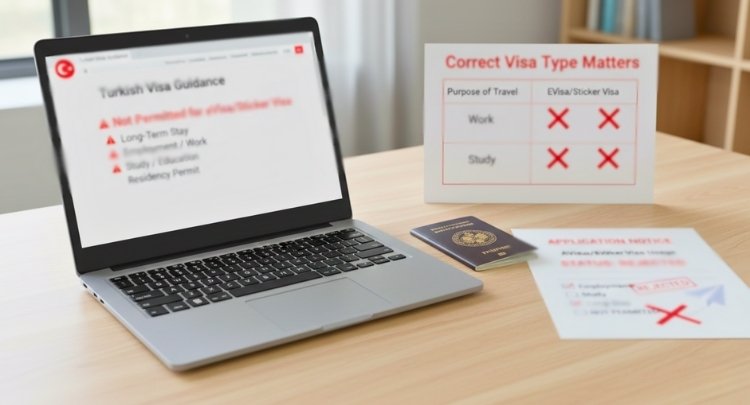
The Turkey eVisa can only be used for tourism, short business trips, or transit. You should not use an eVisa if your reason for going to Turkey is one of the following:
- Work or employment
- Studying in Turkey
- Long-term stay
- Family reunification or living with a relative
- Medical treatment that needs long stay
- Anything other than simple tourism, business or transit trips
In these cases, an eVisa won’t work and you must apply for a different visa through a Turkish embassy instead.
3. When Your Passport Rules Aren’t Met
An eVisa may not be valid if your passport does not meet the required conditions (such as having enough time left before expiry). If you don’t meet the passport rules for an eVisa, you may need to choose a sticker visa or another visa type.
4. When You Want to Stay Longer Than Allowed
The eVisa and some sticker visas are only meant for short stays (often up to 90 days). If you want to stay longer than that, or your purpose is long-term, then you should look for the correct visa type through the embassy.
5. When Your Application Is Not Eligible
If you don’t meet the eligibility rules for an eVisa, don’t apply for one. Some people need to go straight to the embassy process because their nationality isn’t eligible for an eVisa.
6. When You Plan to Work Legally in Turkey
If your goal is to work legally in Turkey, you must apply for a work visa through the consulate and possibly a work permit too. An eVisa is not meant for this.
7. When You Plan to Study in Turkey
If you want to study in a Turkish school or university, an eVisa will not be enough. You must apply for a proper student visa with the embassy.
Choosing the right visa avoids stress and entry problems. Wrong visa use can cause delays or denial. Always match your travel purpose with visa rules. Checking early helps you travel with confidence and clarity.
FAQs about Turkey eVisa VS Sticker Visa- What are the Key Differences?
Choosing between a Turkey eVisa and a sticker visa can be tricky, especially if it’s your first time. Even though both visas let you visit Turkey, they have different rules and uses. To help you understand things better, here are some frequently asked questions that cover important points people often miss.
Can I Change From a Turkey eVisa to a Sticker Visa After Applying?
Once you apply for a Turkey eVisa, you can’t switch it to a sticker visa. If you need a different visa type, you must cancel your eVisa plan and apply through the embassy from the beginning. Both visa types have different processes and rules. It’s important to know your travel reason before applying.
What Should I Do if I Made a Mistake on My Turkey eVisa Application?
If you entered wrong information in your eVisa form, you will need to start a new application. Most mistakes, like name spelling or passport number, cannot be fixed after submission. This is why checking your form before payment is very important. Even small errors can lead to problems at the airport.
Can I Extend My Turkey eVisa or Sticker Visa After Arriving in Turkey?
No, you usually cannot extend a Turkey eVisa or sticker visa once you are in the country. If your allowed time ends, you must leave Turkey and reapply from outside. Staying longer without permission can lead to fines or a future travel ban. Always plan your stay within the approved visa dates.
What Happens if My Turkey Visa Application is Rejected?
If your eVisa or sticker visa is rejected, you won’t be allowed to enter Turkey with that visa. The system or embassy will usually not give a detailed reason. You can apply again, but only after correcting the problem or waiting a few weeks. Reading all rules and submitting correct documents can help avoid rejection.
Is There Any Visa Option for Travelers With Urgent Travel Plans?
Yes, for urgent trips, the Turkey eVisa is often the better choice because it is processed quickly. Some travelers receive their eVisa within a few hours. However, there is no special fast-track system for sticker visas at the embassy. That’s why people with emergency plans usually prefer the eVisa.
Can I Apply for Both a Turkey eVvisa and Sticker Visa at the Same Time?
No, you should not apply for both visa types together. The Turkish system does not allow two active visa applications at once for the same person. You must pick one visa type based on your travel reason and follow its process fully. Applying for both can create confusion and may delay your travel.
End Note
Choosing the correct Turkey visa makes travel smoother and stress free. Each option fits a different travel need, stay length, and purpose. Knowing rules early helps avoid rejection, delays, or extra costs. When plans are clear, the visa choice becomes simple and travel feels more confident from the start.
Many travelers ask, Turkey eVisa VS Sticker Visa- what are the key differences? The short answer is speed and purpose. The eVisa is fast, online, and best for short visits. The sticker visa takes longer but supports work, study, and long stays that need deeper approval.
Before applying, always check your nationality rules and travel purpose carefully. Apply early and keep documents ready. Follow official sources only to avoid mistakes. Smart planning saves time and money. Wishing you a smooth visa process and a great experience during your time in Turkey.