
Canada conference visas support event travel. They help applicants attend professional gatherings. Applicants must meet eligibility rules.
To understand how to apply for a Canada conference visa from Ethiopia, applicants submit an online visitor visa application through IRCC with invitations, funds proof, travel purpose letter, biometrics in Addis Ababa, required fees, then wait for processing after completing forms carefully and checking document accuracy before final submission online successfully.
In the following guide we’ll explains requirements clearly and helps applicants avoid mistakes during preparation and submission stages easily and confidently. Follow along to gain confidence, save time, and improve approval chances with practical advice from experienced visa guidance.
Latest Canada Conference Visa Updates for Ethiopian Applicants (2025–2026)

As of 2025–2026, Canada’s visitor visa process — including for conference attendees — is primarily conducted online through the official IRCC portal. Most Ethiopian applicants aged 14–79 must provide biometrics (fingerprints and photo) as part of the application.
Processing times vary widely and depend on how complete and accurate your submission is. Finally, even if your visa is approved, entry at the Canadian border is granted at the discretion of the border officer.
Is There a Canada Conference Visa?
Canada does not issue a separate conference visa for international visitors, including applicants traveling from Ethiopia. Instead, people attending conferences, academic events, or professional meetings must apply for a Temporary Resident Visa, commonly called a Visitor Visa. This category covers short, unpaid activities and follows standard visitor immigration rules.
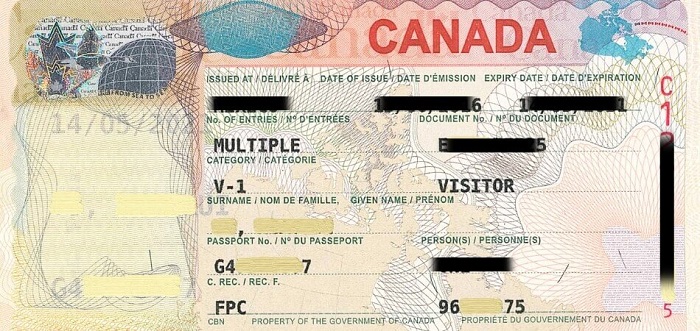
No Separate Conference Visa Category
Canada immigration rules do not list a conference visa as an independent visa category for travelers. Conference attendance falls under the Temporary Resident Visa used for short business or academic visits. Applicants must follow the same process, documents, and eligibility rules applied to other visitor visa applicants worldwide.
Visitor Visa for Business or Academic Purpose
Conference travelers apply under the Visitor Visa with a business or academic travel purpose noted. This purpose includes professional learning, knowledge sharing, and industry networking at recognized events. Applicants must clearly explain the conference purpose using invitation letters, schedules, and supporting documents during the application process.
Activities You Are Allowed to Do
Holders of a visitor visa may attend conferences, seminars, workshops, and short academic meetings in Canada. You may listen, participate in discussions, present unpaid research, and network with professionals. These activities must remain temporary and connected directly to the stated conference purpose mentioned in your application.
Activities That Are Not Allowed
Visitor visa holders cannot work for a Canadian organization or receive payment inside Canada. Long-term academic programs, internships, or employment activities are strictly prohibited under this visa. Enrolling in extended study programs or earning income can lead to visa refusal or future immigration problems.
Purpose Clarity Matters
Immigration officers carefully assess whether your stated conference purpose matches visitor visa conditions. Clear explanations help officers understand your intent and confirm temporary travel plans. Vague or confusing purposes often lead to refusals, especially when employment or study intentions appear unclear or unsupported.
Canada Conference Visa Requirements for Ethiopian Applicants
To attend a conference in Canada, Ethiopian applicants must apply for a Temporary Resident Visa (Visitor Visa) and submit clear supporting documents. These documents help Canadian immigration officers confirm your travel purpose, financial stability, and intention to return to Ethiopia after the conference ends. Here are the required documents checklist:
- Valid Ethiopian Passport: Your passport must be valid for the entire stay and have at least one blank page.
- Conference Invitation Letter: An official invitation showing event details, dates, location, and your role as an attendee or speaker.
- Proof of Funds (Bank Statements): Recent bank statements showing you can cover travel, accommodation, and daily expenses in Canada.
- Employment, Business, or Student Letter: A letter from your employer, business registration, or school confirming your current status in Ethiopia.
- Purpose of Travel Letter: A short explanation describing why you are attending the conference and your planned activities.
- Proof of Ties to Ethiopia: Evidence such as a job, business, family, or property showing strong reasons to return home.
- Digital Passport Photo: A recent photo meeting IRCC size and quality requirements.
- Travel History (If Available): Copies of previous visas or entry stamps can support your application but are not mandatory.
Meeting these requirements does not guarantee visa approval, as each application is reviewed individually by IRCC. When preparing documents for international conferences in Canada 2026 with invitation letter, applicants should ensure every detail supports their travel purpose. Always submit accurate, complete records and apply early, since weak or missing evidence can cause delays or refusal.
How to Apply for a Canada Conference Visa from Ethiopia?
Applying for a Canada conference visa from Ethiopia follows a clear visitor visa process set by IRCC. Careful planning, correct documents, and timely action help avoid delays. Each step builds on the previous one, so accuracy and focus matter from the beginning.
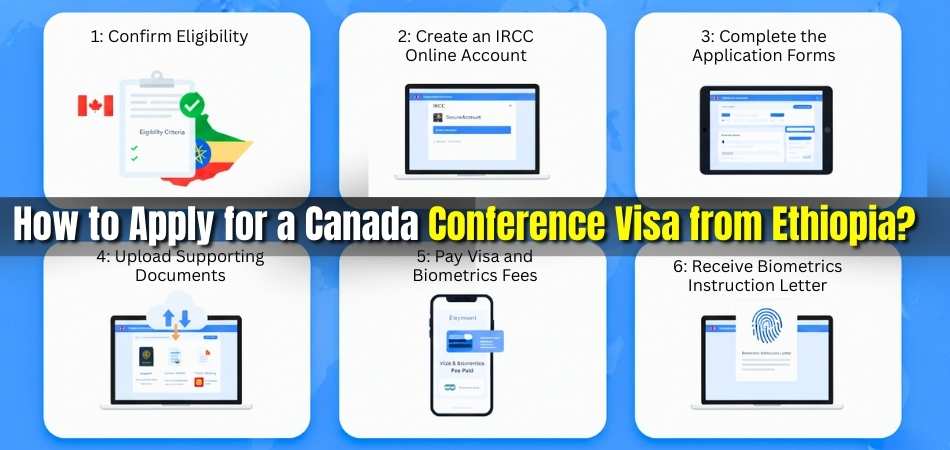
Step 1: Confirm Eligibility
- Start by confirming that your visit fits the visitor visa category for conferences and short professional events. Make sure the conference duration matches your travel plan and clearly supports a temporary stay.
- Review the event agenda and invitation details to confirm relevance to your professional or academic background. Officers expect a logical link between your profile and the conference purpose.
Step 2: Create an IRCC Online Account
- Create an account using GCKey or the IRCC secure portal to access the official application system. Online submission allows faster updates, easier document uploads, and direct communication with immigration officers.
- Use a personal email you check regularly, because IRCC sends important updates through your account dashboard. Missing messages may delay biometrics or decision timelines unexpectedly.
Step 3: Complete the Application Forms
- Fill out the Visitor Visa form IMM 5257 with careful attention to dates, names, and travel history. Every detail must match your supporting documents to avoid confusion or refusal.
- Complete the Family Information form IMM 5707 honestly and consistently, even if family members are not traveling. Officers compare forms closely to check credibility and transparency.
Step 4: Upload Supporting Documents
- Upload documents in the required size and format, usually PDF or JPEG, following IRCC guidelines strictly. Clear scans help officers review your case quickly without requesting replacements.
- Avoid common mistakes like blurry files, missing pages, or incorrect document labels. Small errors can slow processing or weaken the overall application impression.
Step 5: Pay Visa and Biometrics Fees
- Pay the visitor visa fee and biometrics fee online using approved payment methods listed by IRCC. Always check the official fee page because amounts may change without notice.
- Save payment receipts and confirmation pages for your records and future reference. Proof of payment helps resolve issues if technical problems occur later.
Step 6: Receive Biometrics Instruction Letter
- After submission, you will receive a Biometrics Instruction Letter explaining the next required step clearly. This letter allows you to book a biometrics appointment at the Addis Ababa VAC.
- Complete biometrics within the stated deadline, usually thirty days, to keep your application active. Missing this deadline can lead to automatic refusal.
Where to Give Biometrics in Ethiopia (VAC Information)
Giving biometrics forms a required step for Ethiopian applicants applying for a Canada conference visa. This process confirms identity and supports security checks. Knowing the correct location, required items, and booking steps helps applicants prepare smoothly and avoid unnecessary delays.
Canada Visa Application Centre (VAC) in Addis Ababa
Ethiopian applicants give biometrics at the Canada Visa Application Centre located in Addis Ababa city today officially. This location supports fingerprint collection and photographs, helping IRCC manage the conference visa processing timeline for Ethiopia efficiently. Applicants should confirm the address and working hours before travel to avoid scheduling confusion or unnecessary delays.
What to Bring to the Appointment
Applicants must bring their valid passport, biometrics instruction letter, and appointment confirmation on the scheduled day. Staff verify documents before starting the process, so missing items can cause refusal of service. Carry printed copies neatly, because digital versions sometimes create delays during security checks.
Appointment Booking Process
Applicants book biometrics appointments online after receiving the instruction letter through their IRCC account dashboard. The system shows available dates, allowing applicants to choose a suitable time carefully. Early booking helps avoid deadline pressure, especially during busy travel seasons or local holidays.
Role of VAC vs IRCC
The Visa Application Centre only collects biometrics and documents, while IRCC officers review and decide applications. VAC staff cannot influence approval outcomes or provide immigration advice. Understanding this separation helps applicants direct questions correctly and avoid relying on unofficial guidance.
VFS/Addis Ababa Visa Application Centre Tips
The VFS centre in Addis Ababa handles biometrics and some document pickups.
- Location: Bole Sub City, Woreda 03, Omedad Building (confirm current address before your visit, as it may update).
- Tip: Arrive 15 minutes before your appointment but do not come too early because security checks may not let you in before the scheduled time.
Bring printed copies of your instruction letter and passport. Staff check documents before allowing biometric collection. Always check the latest WCC (VFS) website for updates on opening hours.
How Much Does a Canada Conference Visa Cost from Ethiopia?
Knowing the exact costs helps Ethiopian applicants plan confidently and avoid payment mistakes during the visa process. A Canada conference visa falls under the visitor visa category, which includes fixed government fees and possible extra service costs. Always confirm amounts before paying.

Visitor Visa Fee (CAD)
The standard Canada visitor visa fee is CAD 100 per applicant and must be paid online through the IRCC portal. This fee covers application review by immigration officers and remains non-refundable after submission, even if the visa decision is negative.
Biometrics Fee (CAD)
Most Ethiopian applicants must pay a biometrics fee of CAD 85, which covers fingerprint and photo collection. Biometrics are usually valid for ten years, meaning frequent travelers may not need to repay this fee for future applications.
Optional Costs to Consider
Some applicants may need document translation if papers are not in English or French, which adds extra expense. Courier services may also apply when submitting passports or receiving decisions, depending on VAC service choices and local providers.
Always Confirm Fees on the IRCC Website
Visa fees can change due to policy updates or administrative decisions by Canadian authorities. Applicants should always verify the latest costs directly on the official IRCC website before payment. Using outdated figures may cause underpayment and processing delays.
Processing Time for Canada Conference Visa from Ethiopia
Processing time is one of the most common concerns for Ethiopian applicants planning conference travel to Canada. There is no guaranteed timeline, because IRCC reviews each visitor visa application individually. Understanding delays, key factors, and tracking methods helps applicants plan realistically and avoid last-minute stress.
No Fixed Timeline
Canada does not publish a fixed processing time for conference-related visitor visas from Ethiopia. Each application receives individual review based on background checks and document verification. Differences in applicant history, travel purpose, and submission quality naturally affect how long processing takes.
Biometrics Completion
Biometrics completion plays a major role in how quickly IRCC begins reviewing an application. Processing officially starts only after fingerprints and photographs are successfully submitted. Delays in booking or attending biometrics appointments often extend overall waiting time significantly for Ethiopian applicants.
Application Completeness
Complete and well-organized applications usually move faster through the review process. Missing documents, unclear purpose letters, or inconsistent information can trigger additional checks. Officers may request further evidence, which extends timelines and creates avoidable stress for conference travelers.
Seasonal Demand
Processing times often increase during peak travel seasons such as summer and early autumn. Many students, tourists, and conference attendees apply during these months simultaneously. Higher application volume naturally slows reviews, especially for applicants from non visa-exempt countries like Ethiopia.
Check Status Online
Applicants can track their visa status through their IRCC online account dashboard anytime. Updates appear once officers review documents or request additional steps. Checking status regularly helps applicants respond quickly and avoid missing important instructions or deadlines.
Timeline for Ethiopian Applicants
Planning your visa steps early helps keep stress low and plans clear. Many people in Ethiopia face long waits if they start late. This simple guide shows how long each step often takes. Read below to see the full timeline and plan your dates well.
Drafting And Document Prep
Getting papers ready takes about one week when you stay focused and calm. You need an invite letter, purpose note, and proof of funds. Many people use a trusted visa help page like conference visa support to check details and avoid small errors that cause delays later.
Biometrics Appointment Wait
After you send your form, a biometrics letter comes in about two weeks. Addis Ababa slots fill fast, so booking early helps a lot. Many people track dates through online visa tracking tools to avoid missing their turn. Waiting time often runs from two to three weeks for most local applicants.
Visa Processing Time
Once biometrics are done, your file moves to review. This stage often takes two to three months. Simple files move faster when all papers are clear. You can check progress through visa status check pages online. Any missing paper can slow things down, so make sure your file stays clean.
Passport Stamping Stage
After approval, you send your passport for the visa sticker. This step often takes one or two weeks. The visa center will tell you when to drop it. Use courier tracking links to know when it returns. Keep travel plans open until your passport comes back safely to avoid stress.
Total Time Required
Most Ethiopian applicants need about twelve to sixteen weeks in total. That is close to four months for the full process. Busy travel months can add more wait time. Many people start early using visa planning guides to stay safe. Starting four months before travel gives you room to fix any issue.
Starting early helps you stay calm and ready for travel plans. Each step takes time and needs careful care and focus. Using this timeline keeps your dates clear and stress low. Follow these steps to keep your visa plan on track.
Common Reasons for Canada Conference Visa Refusal (Ethiopia)
Canada conference visa refusals often happen because immigration officers find gaps or risks in an application. Understanding common refusal reasons helps Ethiopian applicants prepare stronger documents and avoid repeat mistakes. Clear evidence, consistency, and realistic explanations play a key role in approval decisions.

Insufficient Proof of Funds
Applicants must clearly show enough funds to cover travel, accommodation, and daily expenses in Canada. Weak bank statements, sudden deposits, or unrealistic balances raise concerns for officers. Financial proof should match the trip length and reflect stable, genuine personal or business income.
Weak Ties to Ethiopia
Strong ties to Ethiopia help officers trust that applicants will return after the conference. Weak employment history, unclear business activities, or limited family connections increase refusal risk. Applicants should clearly show commitments such as jobs, studies, businesses, or dependents based in Ethiopia.
Unclear Purpose of Travel
A vague or poorly explained conference purpose often leads to refusal. Officers expect clear details about the event, relevance, and planned activities. Missing agendas, weak invitation letters, or generic explanations can make the trip appear unnecessary or inconsistent with visitor visa rules.
Lack of Travel History
When a person has no past travel records, visa officers may feel unsure about their plans. Past trips show that someone follows rules and returns on time. With no stamps or visas, officers may worry more, so the chance of refusal can be higher than usual.
Inconsistent Information
Inconsistencies between forms, letters, and documents create credibility concerns for immigration officers. Differences in dates, job titles, income figures, or travel history often trigger doubts. Careful review before submission helps ensure all information matches across every document provided.
Previous Refusals Without Explanation
Past visa refusals do not automatically block approval, but ignoring them causes problems. Applicants should clearly explain previous refusals and show what has changed since then. Honest explanations and improved documentation help officers reassess applications more positively.
Tips to Improve Approval Chances: Practical Advice
Improving approval chances for a Canada conference visa requires careful timing, honest information, and well-prepared documents. Ethiopian applicants benefit from early planning and clear explanations that match IRCC expectations. Small details often influence decisions, so thoughtful preparation matters throughout the application process.
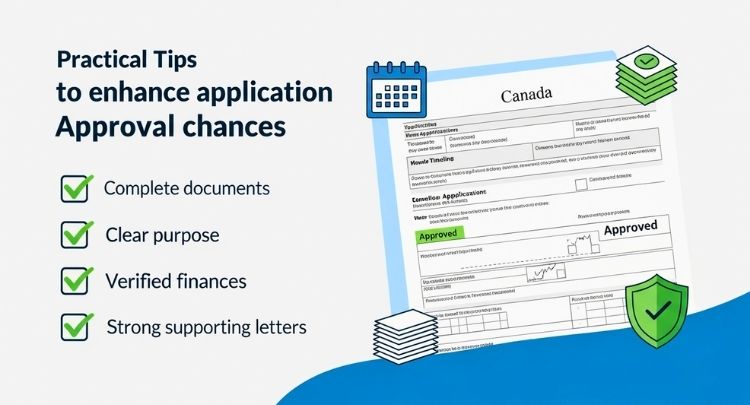
Apply 3–4 Months Before the Conference
Early application gives enough time to handle biometrics, document reviews, and possible delays. Applying late increases stress and reduces flexibility if IRCC requests additional information. Planning ahead also helps manage travel bookings and conference registration without financial pressure.
Submit a Strong Purpose of Travel Letter
A clear purpose letter explains why the conference matters to your career or studies. It should connect your background with event topics, dates, and outcomes. Officers value logical explanations, especially when reviewing costs like conference visa fees from Ethiopia to Canada within your travel budget.
Show Realistic Travel and Accommodation Plans
Present travel plans that match conference dates, location, and duration accurately. Avoid vague itineraries or luxury bookings that conflict with your income level. Realistic hotel choices and transport plans help officers trust your intent and financial responsibility.
Be Honest About Travel History
Applicants should disclose all past travel, including refusals or overstays, without hiding details. Honesty builds credibility and prevents future complications. Even limited travel history is acceptable when explained clearly with strong supporting reasons.
Explain Any Previous Refusals Clearly
If you faced a past refusal, explain it directly and calmly in a separate letter. Highlight what changed since then, such as improved finances or stronger ties. Clear explanations help officers reassess your application fairly.
Sample Documents (Optional but High-Value)
Sample Conference Invitation Letter
[Conference Organizer Letterhead]
Date: [DD/MM/YYYY]
To Whom It May Concern,
This letter confirms that [Full Name], passport number [XXXX], has been invited to attend [Conference Name], taking place in [City, Canada] from [Start Date] to [End Date]. The conference focuses on [brief topic].
The attendee will participate as [attendee/speaker/presenter]. No employment or payment will be provided. For verification, contact [email/phone].
Sincerely,
[Name]
[Title]
[Organization]
Sample Purpose of Travel Letter
Date: [DD/MM/YYYY]
Dear Visa Officer,
I am applying for a Canadian visitor visa to attend [Conference Name] in [City], Canada, from [dates]. This conference directly relates to my professional background as [job title/student field] in Ethiopia.
Attending this event will improve my knowledge and professional skills. I will return to Ethiopia after the conference to continue my work with [employer/business/school]. I have attached proof of funds and employment.
Thank you for your consideration.
Sincerely,
[Full Name]
[Passport Number]
Sample Explanation Letter After Refusal
Date: [DD/MM/YYYY]
Dear Visa Officer,
I respectfully submit this letter to address my previous visa refusal dated [date]. The refusal was based on [reason stated by IRCC]. Since then, I have taken clear steps to improve my application.
I now provide stronger proof of funds, clearer travel purpose, and updated employment documents. I kindly request a fresh review of my application based on the attached evidence.
Thank you for your time and consideration.
Sincerely,
[Full Name]
[Passport Number]
What Happens After Visa Approval?
Receiving approval for a Canada conference visa is an important milestone, but several steps still follow before and after travel. Ethiopian applicants must understand how passport submission works, how long they may stay, what happens at the border, and the rules for remaining in Canada beyond the conference period.

Passport Request Process
After approval, IRCC sends a Passport Request Letter (PPR) through your online account or email. This letter explains how and where to submit your passport, usually at the Canada Visa Application Centre (VAC) in Addis Ababa. The VAC places the visa counterfoil in your passport and returns it after processing. You must follow the instructions carefully, include required forms, and use approved courier options if applicable. Delays often occur when applicants submit passports late or miss required documents.
Visa Validity vs Length of Stay
Visa validity refers to the period during which you can use the visa to enter Canada, not how long you can remain inside the country. For example, a visa may be valid for several months or years. However, the actual length of stay is decided by the border officer at entry, commonly up to six months. The officer may stamp your passport or issue a visitor record stating the exact date you must leave Canada.
Border Inspection Rules
At the Canadian port of entry, border officers conduct a final assessment of your visit. They may ask about your conference, travel plans, accommodation, return ticket, and financial support. Officers can request to see documents you submitted with your application, including the invitation letter. Honest answers and consistent documents are essential. Even with a valid visa, officers can deny entry if they believe the visit does not meet visitor visa conditions.
Staying Beyond the Conference
If you wish to remain in Canada after the conference, you must respect the conditions of your visitor status. You cannot work or study without proper authorization. If you need more time, you must apply for a visitor status extension before your authorized stay expires. Applying late or overstaying can harm future visa applications. Extensions are not guaranteed and require valid reasons and proof of funds.
What If Your Canada Conference Visa Is Refused?
A Canada conference visa from Ethiopia requires a Temporary Resident Visa (TRV), treated as a visitor visa for attending events like conferences. The official fees from Immigration, Refugees and Citizenship Canada (IRCC) apply regardless of origin country.
No Formal Appeal for Visitor Visas
A conference visa for Canada falls under the category of a temporary resident visa (TRV), also known as a visitor visa. If your application is refused, there is no formal appeal process available under Canada’s Immigration and Refugee Protection Act. This means you cannot challenge the decision through a standard administrative appeal like those available for some permanent residence applications or sponsorships. Instead, your options are limited to requesting a reconsideration (an informal review by IRCC), reapplying with improved documentation, or, in rare cases where you believe there was a significant error in law or procedural fairness, pursuing a judicial review in the Federal Court of Canada.

Requesting reconsideration involves submitting a polite, evidence-based request via IRCC’s web form or the visa office that processed your application, explaining why you think the decision should be revisited (e.g., if key documents were overlooked). However, this is not guaranteed to succeed and is not an official right—IRCC may simply reaffirm the refusal. Judicial review is a more formal court process, but it’s time-sensitive (you typically have 15-60 days to apply, depending on where you applied from) and focuses only on whether the decision was reasonable or fair, not on re-evaluating the merits of your case.
How to Reapply Correctly
You can reapply for a visitor visa at any time unless your refusal letter specifically states otherwise (e.g., due to misrepresentation, which could lead to a ban). However, simply resubmitting the same application or using an agent without changes will likely result in another refusal, as the assessing officer will see no new information to alter their assessment. To reapply effectively:
- Review the Refusal Letter Thoroughly: IRCC provides reasons for refusal, such as concerns about your intent to leave Canada after the conference, insufficient ties to your home country, inadequate funds, or incomplete documentation. Address each point directly in your new application.
- Gather New or Stronger Evidence: Include updated documents that demonstrate changes in your circumstances. For a conference visa, this might mean:
- A detailed itinerary and proof of conference registration/invitation.
- Stronger proof of ties to your home country (e.g., employment letters, property ownership, family obligations).
- Financial statements showing sufficient funds for the trip without working in Canada.
- Travel history or previous visas to show compliance with immigration rules. If medical or criminal issues were factors, provide clearances or explanations.
- Submit a Complete Application: Follow the IRCC application guide precisely—use the correct forms, pay fees, and ensure all supporting documents are translated if needed. Be honest and consistent; any discrepancies can lead to further issues.
- Consider Timing: Apply well in advance of your conference (processing times vary by country but can take weeks or months). If biometrics were already submitted, you may not need to redo them for the next application.
Reapplying with these improvements increases your chances, but success depends on how convincingly you overcome the original concerns.
When Professional Advice May Help?
Seeking help from a professional isn’t always necessary for a straightforward refusal, but it can be beneficial in certain scenarios to avoid repeated mistakes and strengthen your case:

- Complex Refusal Reasons: If the letter cites vague or legal grounds (e.g., “purpose of visit not credible” or procedural errors), a registered immigration consultant (RCIC) or lawyer can interpret it and craft a targeted response or reconsideration request.
- Multiple Refusals: If you’ve been refused more than once, professionals can identify patterns and provide strategies, such as gathering specialized evidence or advising on alternative visa types.
- Urgent or High-Stakes Situations: For time-sensitive conferences, or if the refusal involves potential bans (e.g., for misrepresentation), expert guidance can help navigate options like expedited processing or judicial review.
- Lack of Confidence in DIY: If English/French isn’t your strong suit, or you’re unfamiliar with IRCC processes, professionals ensure compliance and professionalism.
Only use authorized representatives—check IRCC’s registry for RCICs or lawyers to avoid scams. Costs vary, but they can review your application before submission or handle the entire process. If your case involves potential errors by IRCC, a lawyer experienced in immigration law might be ideal for judicial review. Always weigh the benefits against the fees, as simple cases might resolve with self-directed reapplication.
FAQs about Applying for a Canada Conference Visa from Ethiopia
Applying for a Canada conference visa from Ethiopia raises many practical questions beyond basic requirements. These FAQs address common concerns applicants face during planning and submission. Each answer offers clear guidance to help avoid mistakes and delays.
Can I Apply Without Paying the Conference Registration Fee?
Yes, you can apply without full payment if you provide a valid invitation or conditional acceptance letter. However, proof of registration or payment strengthens your application by showing genuine intent. Officers may question seriousness if no registration evidence appears.
Do I Need a Medical Exam for a Canada Conference Visa?
Most conference visa applicants do not need a medical exam for short stays. IRCC only requests medical exams in specific cases, such as long stays or health-related concerns. Applicants should wait for instructions instead of arranging exams independently.
Can Self-Employed Applicants Apply for a Conference Visa?
Self-employed applicants can apply by submitting business registration, tax documents, and proof of income. A strong purpose letter explaining how the conference benefits the business is important. Officers focus on financial stability and genuine professional intent.
Is Travel Insurance Mandatory for the Application?
Travel insurance is not mandatory for visa approval, but it is highly recommended. Having insurance shows preparation and responsibility. Some border officers may ask about medical coverage, especially for longer stays or older travelers attending conferences.
Can I Change My Travel Dates After Submitting the Application?
Yes, minor date changes are usually acceptable if the conference dates remain valid. However, major changes may require explanation through your IRCC account. Always ensure your travel plan still matches the invitation letter and purpose of travel.
Will Owning Property in Ethiopia Help My Application?
Property ownership can strengthen proof of ties to Ethiopia but does not guarantee approval. Officers consider it alongside employment, family, and financial evidence. Clear documentation helps demonstrate long-term commitments that support your intention to return.
Can I Attend Multiple Conferences on One Visitor Visa?
Yes, attending multiple conferences is allowed if they fit within your authorized stay period. You must explain all events clearly in your purpose letter. Officers expect realistic schedules and sufficient funds covering the entire travel duration.
Do I Need to Submit Flight Tickets Before Approval?
IRCC does not require confirmed flight tickets before approval. A flight reservation or travel plan is enough. Purchasing non-refundable tickets early is risky, since visa approval is never guaranteed and processing times can vary.
Closing Remarks
Applying carefully makes the visa process smoother and reduces avoidable stress. Every form, document, and statement must match clearly, because officers check details closely. If you spot a mistake after submission, update your IRCC account or provide an explanation letter quickly.
Ignoring errors can cause delays, refusals, or future travel issues. Understanding how to apply for a Canada conference visa from Ethiopia helps applicants follow the correct steps with confidence. Wrong information, missing papers, or unclear intent often lead to rejection. Accurate preparation protects your travel plans and credibility. Careful review, early action, and honest explanations always support better outcomes.