The U.S. Embassy handles thousands of visa applications each year, including those for business trips, conferences, and meetings. Applicants must meet financial and travel requirements. Submitting proper documents helps support your case. Understanding how embassies review those documents can improve your chances of approval.
So, does the USA embassy verify a bank statement for a conference visa?
Yes, the U.S. Embassy can review and verify bank statements for conference-related visas, usually under the B-1 or B-2 category. While not every application is formally verified, consular officers closely assess balances, transaction history, and credibility to ensure applicants can fund their trip and intend to return home.
Explore what makes a strong bank statement for conference visa applications. Learn how officers assess financial documents during review. Keep reading to prepare your application with confidence and avoid common mistakes.
What Visa Category is Used for Conferences in the U.S.?
The primary visa category used for attending conferences in the U.S. is the B-1 Temporary Business Visitor visa, which covers activities such as participating in business, professional, educational, or scientific conventions and conferences without engaging in paid employment. This visa is typically issued as a combined B-1/B-2 (business and tourism) but is specifically for short-term business purposes like conferences.
Key Eligibility and Requirements for B-1

- You must demonstrate that your visit is temporary, for legitimate business activities, and that you intend to return to your home country.
- Provide evidence such as a conference invitation, itinerary, proof of ties to your home country (e.g., job, family, property), and sufficient funds for the trip.
- Application involves Form DS-160, a visa interview at a U.S. embassy or consulate, and fees (around $185 as of current rates, subject to change).
- Validity is usually 1-10 years with multiple entries, but each stay is limited to up to 6 months (extensions possible in some cases).
Alternatives Depending on Circumstances
- Visa Waiver Program (VWP): If you’re from one of the 41 participating countries (e.g., most EU nations, UK, Australia, Japan), you may enter visa-free for up to 90 days for business activities like conferences, but you need Electronic System for Travel Authorization (ESTA) approval in advance.
- Other Categories: For academic or exchange programs (e.g., researchers or students presenting at conferences), a J-1 Exchange Visitor visa might apply instead. If already in the U.S. on an F-1 (student) or H-1B (specialty occupation) visa, you may attend without a new visa, provided it aligns with your status. Canadians and Bermudians often don’t need a visa for such short business visits.
Always check the U.S. Department of State website or consult an embassy for your specific situation, as rules can vary by nationality and conference type.
Does the USA Embassy Verify a Bank Statement for a Conference Visa?
If you have an application for a B-1 or B-2 conference visa, the USA Embassy can review and verify the bank statements. While not every application is formally verified, consular officers closely assess balances, transaction history, and credibility to ensure applicants can fund their trip and intend to return home.
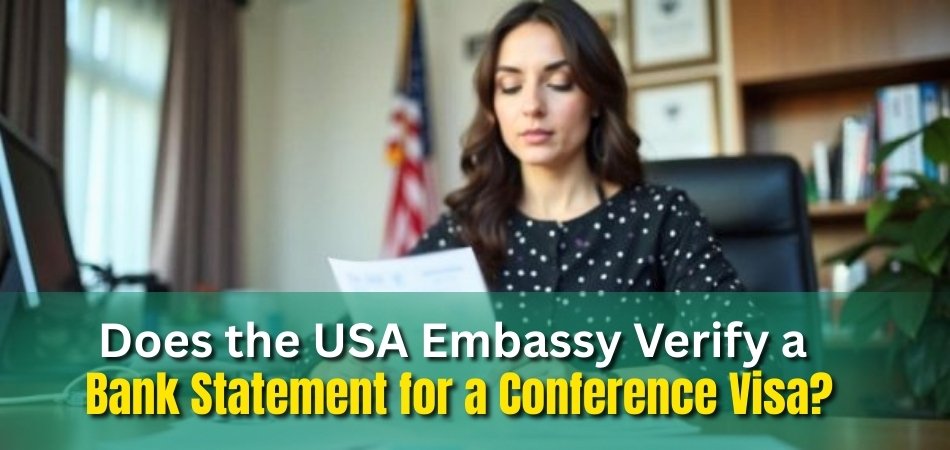
The U.S. Embassy reviews bank statements to understand your travel readiness and personal stability, and these checks help officers judge risk, honesty, and intent using clear financial patterns while ensuring applicants meet visa requirements fairly and consistently.
Proof of Sufficient Funds
- Statements show you can pay for flights , hotels, meals and fees without stress during a conference in USA trip.
- Clear balances help officers judge trip plans fit your income level and avoid unrealistic spending risks abroad today.
- Regular transactions show steady cash flow which supports honest funding sources and reduces doubts quickly for officers.
Evidence of Home-Country Ties
- Savings patterns reveal ongoing duties like rent loans or family costs that pull applicants back home afterwards.
- Stable income deposits link employment or business activity to local roots officers trust consistently.
- Asset balances support claims of return plans when travel ends and responsibilities continue after visits.
Public Charge Prevention
- Officers confirm visitors can fund daily needs without seeking public help or illegal work during stays there.
- Strong finances reassure officials you will not burden services meant for residents during visits abroad temporarily periods.
- Clear funding plans protect applicants from refusals tied to public charge rules set by law today nationally.
Fraud Detection and Authenticity
- Embassies watch for sudden deposits that suggest borrowed money or document manipulation attempts before interviews occur there.
- Consistent statements reduce suspicion and speed decisions during short interviews with officers present today worldwide often quickly.
- Officers compare statements with jobs tax records and travel plans to confirm honesty consistently during reviews there.
Consistency With Application Details
- Financial records must align with forms, interviews and invitations to avoid mixed messages for officers reviewing files.
- Matching figures build trust and help officers approve cases faster without extra questions or delays at later stages.
- Clear explanations for gaps or changes prevent confusion during assessment by officers handling files daily at consulates.
How Consular Officers Evaluate a Bank Statement: Detailed Breakdown
Consular officers at U.S. embassies and consulates review bank statements as a critical part of nonimmigrant visa applications (e.g., B-1/B-2 for business, tourism, or conferences) to assess an applicant’s financial credibility. This evaluation helps determine if the applicant can financially support their trip without becoming a public charge (under INA section 212(a)(4)) and has strong ties to their home country to overcome the presumption of immigrant intent (under INA section 214(b)).
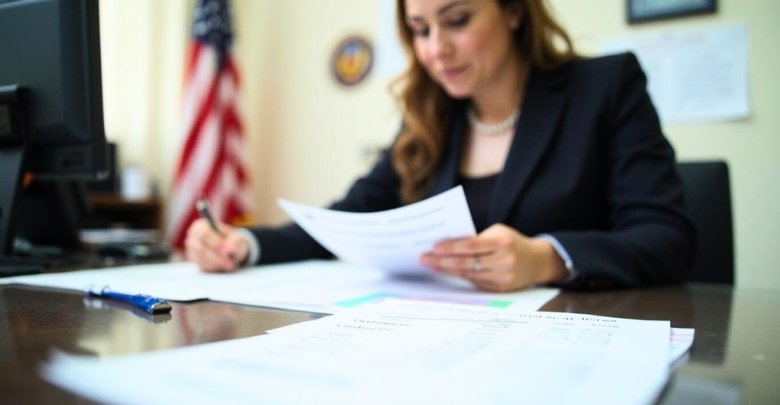
Officers conduct this review during the visa interview, often cross-referencing statements with other documents like pay stubs, tax returns, or employment letters. There’s no fixed minimum balance; instead, the focus is on overall plausibility based on the applicant’s itinerary, income, and circumstances.
Bank statements are typically requested for the last 3-6 months (sometimes up to a year for certain visas), and applicants should bring originals plus copies to the interview. Digital versions are acceptable if official and verifiable, but stamped or certified copies are preferred to avoid suspicion. If statements are in a foreign currency, officers expect clear conversions to U.S. dollars using official exchange rates for quick assessment.
Bank Statement Checks Differ by Country
U.S. embassies in countries with higher fraud risk, such as India, Nigeria, Bangladesh, and the Philippines, often perform direct verification with banks or employers. This may include phone calls or document checks. In low-risk countries like the UK, Japan, or Germany, detailed verification is less common, but officers still review financial patterns carefully.
Detailed Breakdown of Evaluation Criteria
Consular officers use a holistic approach, weighing multiple factors rather than isolated metrics. Below is a step-by-step breakdown of how they typically evaluate bank statements, drawn from official guidelines and common practices.
Authenticity and Verification:
- Officers first check for signs of fraud or alteration, such as inconsistent formatting, pixelated scans, cropped sections, or edited transaction data. They may use digital forensics tools or compare details (e.g., account numbers, bank logos) against known standards.
- Verification can involve direct contact with the bank via phone, email, or in-person checks to confirm balances and transaction history. Embassies often collaborate with specialized agencies accessing global financial databases for cross-verification.
- Red flags include mismatched information with other documents (e.g., salary in employment letters not aligning with deposits) or poor-quality submissions (e.g., low-resolution PDFs or incomplete date ranges). Fake statements are common and viewed with high suspicion, potentially leading to permanent ineligibility if detected.
Sufficiency of Funds:
- Officers assess if the balance and transaction history demonstrate enough money to cover all trip expenses, including flights, accommodation, daily living, conference fees (if applicable), and a buffer for emergencies—typically 25-30% above estimated costs. For example, a short conference trip might require proof of $2,000-$5,000 or more, depending on location and duration, while student visas (e.g., F-1) often need evidence of $2,000 per month plus dependents’ costs.
- They calculate based on your itinerary: no universal minimum exists, but funds must be “reasonable” relative to your income and trip plans. When applying for international conferences in the USA, financial proof becomes even more important because officers must confirm you can cover travel, lodging, meals, and other expenses. If sponsored, an Affidavit of Support (Form I‑134) with the sponsor’s bank statements may be required to demonstrate financial reliability and reduce risk concerns.
- During the interview, officers may ask probing questions like “How will you fund your stay?” or “Explain this transaction” to verify understanding of your finances.
Consistency and Stability of Financial History:
- A steady pattern of deposits (e.g., salary credits) and withdrawals over months is preferred, showing ongoing financial stability rather than one-time boosts. Regular activity indicates a “lived-in” account, not one padded for the application.
- Officers look for transaction patterns that align with your declared income and lifestyle. For instance, consistent inflows from employment reassure them of your ability to sustain yourself abroad without working illegally.
- Thin histories (e.g., only 1-2 months of statements) or stale documents (e.g., ending months before the application) are red flags, as they prevent a full assessment.
Evidence of Ties to Home Country:
- Bank statements help prove strong financial obligations or assets in your home country (e.g., savings, investments, or property-related payments) that motivate your return. This includes ongoing expenses like loan repayments or family support, which tie into the 214(b) requirement.
- Officers evaluate this alongside other ties (e.g., job, family), ensuring the overall profile shows temporary intent rather than permanent relocation.
Common Red Flags and Potential Denials:
- Sudden Large Deposits: Often seen as “show money” from loans or relatives, withdrawn post-interview; these raise doubts about genuine funds.
- Irregular or Suspicious Activity: Overdrafts, minimal activity, or patterns suggesting manipulation (e.g., borrowed funds).
- Inconsistencies: Mismatches with other evidence, like tax returns or sponsor documents, can lead to further scrutiny or denial.
- If issues arise, applications may be denied under 214(b) for weak ties or 212(a)(4) for public charge risk, but reapplications with updated evidence are possible.
Tips for Preparing a Strong Bank Statement
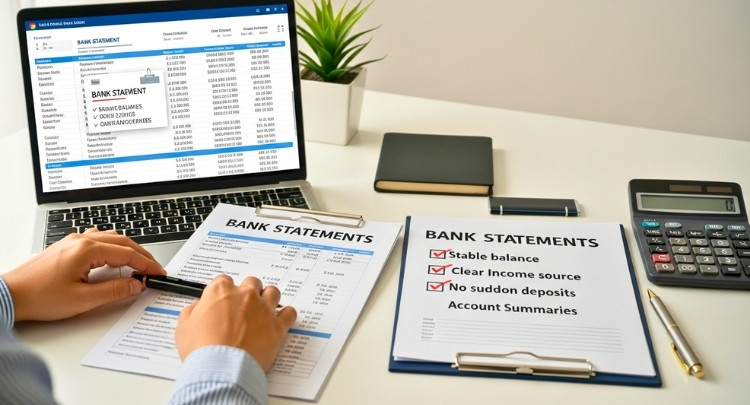
Preparing a strong bank statement improves credibility and reduces delays during visa interviews. Officers expect clear financial records that match your personal situation and travel plans. Following practical preparation steps helps avoid confusion, suspicion, and unnecessary questions during the assessment process.
Maintain A Stable Account History
Keep your bank account active with normal income and expenses for at least six months before applying. Regular transactions show genuine financial habits and reduce concerns about temporary deposits added only to satisfy visa requirements during review.
Submit High Quality Bank Statements
Use clear full-color bank statements with high resolution covering the full required period without missing pages. Avoid screenshots cropped files or edited documents because poor quality records raise doubts about authenticity and accuracy.
Prepare Sponsor Documents Carefully
If a sponsor supports your trip include their bank statements along with proof showing your clear relationship. Officers expect sponsor finances to realistically cover expenses and match statements provided in affidavits or invitation documents.
Explain Financial Irregularities Honestly
Be ready to explain unusual deposits gaps or transfers calmly during the interview if officers ask questions. Honest clear explanations supported by documents help officers trust your financial story and avoid unnecessary refusals.
Check Embassy Specific Guidelines
Always review the official embassy website or travel.state.gov for location specific requirements before applying. Practices may vary by country visa category or workload so updated guidance helps prevent preparation mistakes.
Sample Interview Answers for Common Bank Statement Questions
If your company paid for the trip
“My employer is sponsoring this conference. The company paid the registration fee and will cover my flight, hotel, and daily expenses. I have brought the company sponsorship letter and their payment records.”
If a family member sent you money
“My father sent me money from his business income to support this trip. I have his bank statement and proof of our relationship.”
If you received a large deposit
“I sold a piece of land last month. The funds were deposited into my account. Here is the sale agreement and bank confirmation.”
These answers match what consular officers expect under U.S. visa interview standards.
Are Local-Currency Bank Statements Acceptable?
Yes, local-currency bank statements are generally acceptable for U.S. visa applications, including conference travel under the B-1 category, as consular officers routinely assess finances by converting balances into U.S. dollars during review. Applicants do not need mandatory USD statements, but clarity, accuracy, and proper presentation help officers quickly judge financial sufficiency and home-country ties.
Currency Conversion And Financial Assessment
Consular officers review balances by converting local currency into U.S. dollars using current exchange rates during assessment. Applicants may include a simple conversion summary to improve clarity, though officers do not require applicants provide conversions. Clear balances help officers confirm funds cover travel costs, living expenses, and conference fees realistically.
Language And Translation Requirements
When statements appear in non-English languages, applicants must submit certified English translations with original documents attached. Translations should remain accurate complete and professionally certified to avoid confusion or credibility concerns during interviews. Clear translations help officers review figures quickly without delaying decisions or requesting additional explanations.
Visa Type And Embassy Specific Practices
Visitor visas generally allow local-currency statements, while student visas may require stricter financial presentation standards. Some embassies or universities request USD figures or clearer conversion summaries for faster evaluation. Applicants should always review the specific embassy website because local practices and expectations sometimes differ by location.
Do Crypto or PayPal Balances Count?
Crypto or PayPal money does not usually count as main proof of funds for a United States visa because visa officers need to see money held in a regular bank that can be checked easily and used quickly to pay for travel and daily costs.
Crypto wallets, PayPal, and fintech apps are not seen as stable or easy to confirm since values can change fast and some funds take time to move into cash which makes officers worry if the money will really be there when needed.
You can still mention crypto or online balances as extra assets in your file but your main proof should be bank statements from a normal bank that show steady funds you can use for your trip, living costs, and return travel.
What are the Special Applicant Scenarios?
Special applicant scenarios require extra care because financial profiles differ from standard salaried travelers. Consular officers adjust expectations based on income type account structure and financial history, but applicants must still prove stability credibility and temporary intent clearly through supporting documents.
Self-Employed Or Freelancers
Self-employed applicants must show steady income through business bank statements invoices contracts and tax filings. Officers compare deposits with declared work activities to confirm genuine earnings and rule out temporary balance padding for visa purposes.

Students
Students must show sponsor support or personal savings alongside enrollment proof when applying for a conference visa during student visa processing to avoid confusion. Officers expect clear funding sources and reassurance that conference travel does not conflict with study obligations.
Company-sponsored conference travel
If your employer or organization is paying, submit a company sponsorship letter stating:
“All expenses including airfare, accommodation, conference fees, and daily allowance will be covered by [Company Name].”
Attach:
- Company letterhead
- HR or finance signature
Proof of company payments if already made
Joint Or Family Accounts
Joint or family accounts require proof explaining ownership access and contribution patterns clearly. Officers look for evidence that funds remain available to the applicant and not restricted by another account holder.
Newly Opened Accounts And Risk Control
New accounts raise concern unless supported by salary proof asset transfers or business income records. Officers prefer older accounts but may accept newer ones when explanations match documents and financial behavior appears logical.
Common Red Flags That Can Lead to Visa Refusal
Consular officers review bank statements carefully to detect financial risks that may suggest fraud weak ties or unrealistic travel plans. Understanding common red flags helps applicants prepare honest documents and avoid avoidable refusals during visa interviews with better confidence overall.

- Sudden Large Deposits: Officers question recent large deposits that appear shortly before applications and lack clear documented income sources legitimate. Such patterns suggest borrowed show money and reduce trust in financial stability during assessment interviews by officers.
- Short Account History: Accounts opened recently prevent officers from reviewing consistent income patterns over time across several months clearly there. Limited history raises doubts about authenticity and makes verification harder during interviews with embassy staff present today.
- Mismatched Income: When bank deposits do not match declared salaries officers suspect inaccurate information or hidden funding sources elsewhere. These gaps weaken credibility and often trigger deeper questions during the visa interview process with officers present.
- Unexplained Foreign Transfers: Foreign transfers without explanation raise concerns about undisclosed sponsors illegal work or temporary borrowed funds entering accounts suddenly. Officers expect clear proof showing why money moved and whether access remains reliable for applicants during travel.
- Overdependence On Cash Deposits: Heavy cash deposits without salary trails suggest weak income structure and increase fraud suspicion during visa reviews. Officers prefer traceable transfers that match work records and regular financial behavior over longer periods consistently shown.
How to Fix a Weak or Problematic Bank Statement?
If your bank statement has low balance, sudden deposits, or irregular income, you can still protect your application by explaining it clearly with documents.
If you have a large recent deposit, attach:
- Proof of the source such as salary letter, property sale deed, dividend statement, or business invoice
- A short written note explaining when and why the money entered your account
If your income is irregular (freelance, business, or family support), include:
- Contracts or invoices
- Tax returns
- Sponsor or employer letters
U.S. embassies care more about where the money came from than how big the balance is.
What to Bring to Your Visa Interview?
Preparing documents carefully helps consular officers understand your purpose finances and intent clearly during interviews. A complete set of papers reduces confusion saves time and improves confidence when officers assess your application fairly.
Bank Statements
Bank statements show your ability to pay travel living and event costs without financial stress abroad. Officers review recent statements to confirm stability consistency and realistic balances matching your income and travel plans.
Employment Or Business Proof
Employment letters business registrations or contracts confirm how you earn income and why you will return home. Officers compare these records with bank deposits to ensure financial claims match real work activities.
Conference Invitation Letter
A conference invitation letter explains why you travel and how the event fits your professional background. Officers use it to judge trip legitimacy duration and whether activities match allowed visitor visa rules.
Sponsor Documents
Sponsor documents include bank statements support letters and relationship proof showing financial responsibility clearly. Officers assess whether sponsor income realistically covers costs and appears genuine sustainable and consistent.
Tax Records Or Payslips
Tax returns or payslips help confirm income sources and long-term financial behavior accurately. Officers trust official tax records because they support declared earnings and reduce doubts about unexplained deposits.
Travel Plan
A travel plan outlines flights accommodation duration and daily activities clearly and logically. Officers use it to judge cost estimates trip length and whether finances support planned movements.
FAQs about USA Embassy Bank Statement Verifications
Before attending a professional event in the United States, many applicants worry about how closely financial documents are reviewed during visa processing. Bank statements often cause confusion, especially for conference travelers using visitor visas. The following frequently asked questions address concerns not previously covered and explain practical details applicants often overlook.
Can The Embassy Reject A Visa Solely Based On Bank Statements?
Yes, a visa can be refused if bank statements create serious doubts, but refusal rarely depends on finances alone. Officers look at bank statements together with employment history, travel purpose, and home-country ties. If financial records appear inconsistent, unrealistic, or unreliable, they can strongly influence the final decision.
Do Consular Officers Keep Copies Of Bank Statements After The Interview?
In most cases, officers review bank statements during the interview and return them immediately. Copies are usually not retained unless the officer requests additional administrative processing. However, details from the statements may be noted in the case file to support the final visa decision.
Can Bank Statements Be Requested Even If Not Listed On The Embassy Website?
Yes, consular officers can request bank statements even if they are not listed as mandatory documents. The interview is discretionary, and officers may ask for financial proof whenever they need clarification about funding sources, travel feasibility, or the applicant’s ability to support themselves during the visit.
Does The Embassy Compare Bank Statements With DS-160 Information?
Yes, officers often compare bank statements with information provided in the DS-160 form. Income, employment details, and travel plans must align with financial records. Any mismatch, such as income claims unsupported by deposits, may raise concerns and lead to further questioning or refusal.
Are Printed Online Bank Statements Accepted At Interviews?
Printed online statements are usually accepted if they clearly show the bank’s name, account holder details, dates, and transaction history. However, officers may view unstamped or poorly formatted printouts with caution, especially if the statements appear edited or lack verifiable authenticity indicators.
Can Multiple Bank Accounts Be Shown Instead Of One Statement?
Yes, applicants may present multiple bank accounts if needed to demonstrate sufficient funds. Officers will assess the combined financial picture but still expect consistency and clear explanations. Multiple accounts should reflect genuine financial behavior rather than temporary transfers made only to inflate balances.
Do Credit Cards Or Fixed Deposits Replace Bank Statements?
Credit cards and fixed deposits can support an application, but they do not fully replace bank statements. Officers prefer seeing liquid funds available for immediate expenses. Fixed deposits may help show savings, while credit cards demonstrate access to funds, but bank statements remain central.
Will Bank Statements Be Rechecked During Future Visa Applications?
Yes, previous visa records remain on file, and officers may compare current bank statements with past applications. Large unexplained changes in financial status can raise questions. Consistency across applications helps build credibility and shows stable financial circumstances over time.
Does A Conference Invitation Reduce The Need For Strong Bank Statements?
No, a conference invitation alone does not reduce financial scrutiny. Officers still expect proof that the applicant can pay for travel and living expenses. Even when conferences cover partial costs, applicants must show personal or sponsor funds for remaining expenses.
Can Poor Bank Statements Be Offset By Strong Travel History?
Strong travel history can help, but it does not fully offset weak financial records. Officers still need proof of current financial ability. Past compliance with visa rules builds trust, but insufficient or unclear bank statements may still result in refusal despite previous travel experience.
Concluding Thoughts
Planning money papers for a U.S. conference trip should feel simple, not stressful. Officers want to see that your finances make sense and match your travel plan. Many people wonder does the USA embassy verify a bank statement for a conference visa, and the real focus stays on honesty and clear records.
You do not need perfect numbers or large savings to succeed. What matters most is steady income, clear sources, and realistic expenses. Simple statements, matching documents, and calm explanations help officers trust your case. When your story stays clear and believable, the interview becomes easier and smoother overall.