
Knowing how to write a research paper in electrical engineering means following a structured approach that turns complex experiments into clear, valuable insights. Follow three core steps to write properly like: choose a focused technical problem, conduct structured experiments or simulations, and present your findings with clear data and logical reasoning.
This guide explains each step, from choosing your topic to publishing your findings, with practical tips for clarity, structure, and technical precision. Ready to start? Let’s walk through the complete process of writing and presenting your electrical engineering research paper effectively.
How to Write a Research Paper in Electrical Engineering?
Writing a research paper in electrical engineering requires a balance of technical precision and organized structure. Whether you’re a student or professional, following these focused steps will help you turn your ideas into a clear, publishable study. Let’s begin your roadmap toward academic and professional success.

Step 1: Choose a Focused and Feasible Research Topic
Select a topic that genuinely interests you and fills a research gap. Review recent work in power electronics, control systems, or communications through IEEE Xplore, Google Scholar, or ScienceDirect. Exploring conferences in Australia can help you find trending areas and align your research with global discussions. A clearly defined, manageable topic keeps your study original and impactful.
Step 2: Conduct a Comprehensive Literature Review
Study existing research to understand what’s been done and what’s missing. Collect and compare journal papers, noting each author, publication year, methods, and findings. Identify gaps or limitations your study can address. A detailed review builds the foundation for your argument and demonstrates awareness of current developments.
Step 3: Define Objectives and Research Methodology
Frame your research question precisely; what are you trying to solve or prove? Then describe your methodology: simulation, experimentation, or analytical modeling. Mention tools such as MATLAB, Simulink, or PSpice, and define parameters like voltage, frequency, or temperature. A clear, replicable method adds reliability and credibility to your work.
Step 4: Gather and Analyze Data
Collect experimental or simulation data systematically. Ensure accuracy in voltage, current, and frequency readings. Present data visually using graphs, charts, or tables. Compare actual results with theoretical models to highlight improvements or discrepancies that support your conclusions.
Step 5: Structure the Research Paper Properly
Follow the IEEE format for clarity and publication readiness:
- Title Page and Abstract – concise summary of your purpose and results.
- Introduction – outline the research background and objectives.
- Literature Review – explain prior work and your study’s contribution.
- Methodology – detail procedures and tools used.
- Results and Discussion – interpret data and implications.
- Conclusion and Future Work – summarize findings and next steps.
If you plan to attend any conference in Australia, review submission guidelines early, as many accept short papers or posters before full submissions.
Sample Research Paper Template
Title: [Concise Title]
Author(s): [Your Name, Institution]
Abstract: [150–200 words summarizing aim, method, results]
Keywords: [Up to five keywords]
1. Introduction – Define problem and objectives.
2. Literature Review – Summarize related studies.
3. Methodology – Explain methods and tools.
4. Results and Discussion – Present data and insights.
5. Conclusion – Highlight key contributions.
References: [IEEE Style]
Taking the time to plan, write, and refine each section carefully ensures your research communicates value. Follow these steps closely, and your paper will be ready for confident submission or presentation within the engineering community.
Writing Each Section of Your Paper – Practical Breakdown
Writing a research paper is not only about data but also about presentation. Each section should serve a clear purpose, guiding the reader through your study effortlessly. Follow these writing tips to make every part of your paper precise and engaging. Let’s explore each section below.
Crafting a Strong Abstract
Your abstract should capture the entire study in 150–200 words. Clearly mention what was done, why it matters, the methods used, and the key results achieved. For example: “An adaptive PWM control method improved inverter efficiency by 12 percent using real-time feedback.” Keep it factual and concise.
Building a Compelling Introduction

Begin with a broad overview of the topic before focusing on the specific research problem. Explain its global relevance, summarize past research briefly, and end with your paper’s objective. Example: “Renewable energy integration presents stability challenges. This study proposes a control-based approach to enhance grid resilience and performance.”
Presenting Methods Logically
Organize your methods section using subsections for clarity. Describe materials, hardware design, simulations, or algorithms in detail. Explain your setup, parameters, and testing environment. Use diagrams or flowcharts to show the workflow and ensure that another researcher could replicate your work based on your descriptions.
Reporting Results and Analysis Effectively
Present findings clearly through tables, graphs, and charts. Compare your results to theoretical expectations or previous studies. Highlight patterns, improvements, or unexpected outcomes. Then explain what these results mean in practical terms, focusing on accuracy, performance, or efficiency metrics relevant to your field.
Writing a Persuasive Conclusion
Your conclusion should summarize the study’s purpose, approach, and outcomes. Avoid introducing new data. Instead, interpret the significance of your findings and suggest possible applications or next steps. For instance: “Future work will extend this inverter design to a three-phase prototype for higher efficiency testing.”
A well-structured paper captures both logic and clarity. By writing each section with purpose and precision, you build a strong narrative that communicates your contribution effectively.
How to Choose the Right Research Tools and Software?
Selecting the right tools determines how efficiently you can collect data, analyze results, and present your findings. From simulations to writing platforms, each tool plays a vital role in shaping your research quality. Let’s look at the essential software every electrical engineering researcher should use, especially when preparing work for publication or presentation after finding electrical engineering conference in Australia, Canada, or the USA that matches your field.

Simulation Tools for Data Collection and Analysis
MATLAB and Simulink are essential for modeling, control design, and signal processing, offering accurate visualization and mathematical precision. PSpice and Multisim are ideal for circuit simulation, performance optimization, and fault analysis. LabVIEW helps in real-time data acquisition, sensor testing, and automation, making it perfect for hardware-driven experiments.
Citation and Reference Managers for EE Papers
Managing references manually is time-consuming and prone to errors. Tools like Mendeley, Zotero, and EndNote automatically generate citations in IEEE format and store PDFs for easy retrieval. They allow seamless integration with word processors, ensuring your bibliography remains consistent and properly formatted throughout the writing process.
Writing Tools and Platforms for Collaboration
Collaboration is key in modern research. Overleaf provides a LaTeX-based environment for writing IEEE-formatted papers with co-authors in real time. For early drafts, Google Docs offers easy sharing and commenting. IEEE also provides downloadable templates for both Word and LaTeX, helping you maintain a professional standard.
The right mix of software simplifies complex research tasks, enhances accuracy, and saves valuable time. Equip yourself with these tools to focus more on innovation and less on formatting or technical errors.
How to Review and Edit Your Paper Effectively?
A strong research paper is the result of careful writing and even more careful editing. The review stage helps refine clarity, accuracy, and presentation. Before submission, take time to evaluate your paper from both technical and reader perspectives. Let’s explore how to perfect your final draft before publication.
Self-Editing Techniques for Technical Accuracy
Start by verifying all equations, formulas, and symbols for correctness. Ensure measurement units are consistent throughout and that figures and tables are properly numbered. Double-check values, data labels, and legends to confirm they match the text. This attention to precision helps maintain your technical credibility.
Getting Peer Feedback Before Submission
Invite experienced peers, advisors, or supervisors to review your draft. Ask for constructive input on technical accuracy, logical flow, and clarity of argument. Their fresh perspective may reveal inconsistencies, missing explanations, or sections needing simplification, helping you improve both content and structure before final submission.

Checking for Formatting and Citation Consistency
Ensure your paper adheres to IEEE formatting standards. Verify margins, fonts, and section headings are consistent. Cross-check in-text citations with the reference list to avoid missing sources. A clean, uniform layout enhances readability and leaves a professional impression on reviewers and editors.
Final Proofreading Tools
Use proofreading tools like Grammarly, Hemingway App, and QuillBot to refine your writing. These tools help identify awkward phrasing, grammar mistakes, and overly long sentences. Review suggested edits carefully and maintain a formal, technical tone suitable for academic publication.
Conducting a Final Read-through in Print Format
Printing your paper or converting it into PDF format allows you to notice overlooked errors. Read it slowly, focusing on flow, figure placement, and transitions between sections. This visual change helps you catch small inconsistencies that may not appear on screen.
Editing is your final opportunity to strengthen your research and ensure it meets publication standards. With accuracy, structure, and polish in place, your work will stand out to reviewers. Next, we will look at the most common mistakes to avoid when writing your electrical engineering paper.
Common Mistakes to Avoid When Writing EE Papers
Even well-researched papers can lose impact if basic writing and formatting errors go unnoticed. Recognizing and avoiding these mistakes ensures your work maintains clarity, professionalism, and academic integrity. Let’s review the most common issues that weaken electrical engineering research papers and how to prevent them effectively.

Using Acronyms Without Defining Them
Acronyms should always be introduced in full when mentioned for the first time. For example, write “Pulse Width Modulation (PWM)” before using “PWM” later in the text. Undefined abbreviations can confuse readers and reduce the accessibility of your work, especially for interdisciplinary audiences.
Missing Measurement Units
Every numerical value must include its corresponding unit. Leaving out voltage, current, or frequency units can make data meaningless and mislead readers. Double-check that all figures, equations, and tables consistently include standard measurement symbols in compliance with IEEE and SI unit guidelines.
Copy-pasting From Earlier Works
Copying text from previous publications or reports, even your own, can lead to plagiarism issues. Always paraphrase, cite sources properly, and present ideas in your own words. Maintaining originality demonstrates academic honesty and adds credibility to your research writing.
Weak Discussion Without Comparison
A discussion section should go beyond summarizing results. Compare your findings with those from previous studies or theoretical expectations. Highlight what was improved, validated, or challenged through your work. Strong comparisons show critical thinking and make your conclusions more persuasive.
Ignoring IEEE Formatting Rules
IEEE formatting ensures your paper looks professional and readable. Neglecting font size, column structure, or reference style can lead to rejection even before review. Follow official IEEE templates for headings, equations, and citations to meet publication standards.
Overloading Text With Technical Jargon
While technical terms are necessary, excessive jargon can make your paper difficult to read. Explain complex terms briefly and use simple, precise language where possible. Clear communication helps reach both technical experts and broader academic readers effectively.
Paying attention to these details saves time during peer review and enhances your paper’s acceptance potential. Avoiding these common mistakes ensures your research stands out for its clarity and professionalism.
How to Improve the Readability and Impact of Your Paper?
A research paper must not only be technically strong but also easy to read and understand. Readability ensures your work reaches a wider audience and leaves a lasting impression. Here are some practical tips to make your writing clearer and more impactful. Let’s refine your communication style next.
- Write for Both Experts and Beginners: Balance depth with simplicity by explaining technical terms and equations briefly in plain language. Avoid assuming the reader knows every concept. Offering a brief context helps both specialists and new learners grasp the significance of your research without confusion.
- Balance Technical Detail with Clarity: Use formulas and data only when necessary. Instead of filling paragraphs with symbols, describe outcomes in simple words supported by visuals like charts and graphs. Clear explanations paired with visuals make complex information easier to follow and remember.
- Use Active Voice and Short Sentences: Active voice keeps your writing direct and confident. Write “This paper presents a new control strategy” instead of “A new control strategy is presented.” Short sentences reduce ambiguity and maintain the reader’s attention throughout the discussion.
- Maintain Logical Flow Between Sections: Ensure each section connects smoothly to the next. For instance, end the methodology by hinting at upcoming results. Logical transitions guide readers effortlessly and make your paper feel cohesive rather than fragmented.
- Optimize Visual Presentation: Use well-labeled graphs, tables, and figures to illustrate trends. Avoid overcrowding visuals with unnecessary data. A neat, organized layout enhances both readability and aesthetic appeal, leaving a professional impression on reviewers and readers.
Improving readability is about clarity, consistency, and flow. A paper that communicates ideas effortlessly stands out in conferences and journals alike.
How to Get Your Electrical Engineering Paper Published?
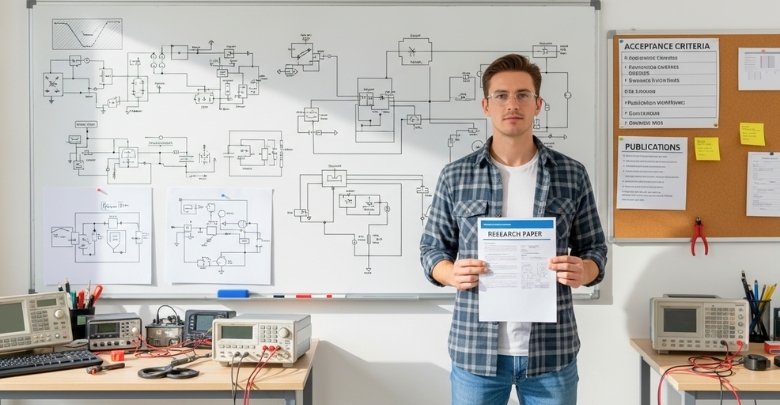
Publishing your research is an important milestone that showcases your contribution to the engineering community. Selecting the right platform, preparing a complete submission, and managing reviews professionally can greatly improve your acceptance chances. Let’s go through the key steps to ensure the successful publication of your paper, especially if you plan to attend electrical engineering conference in Australia, the USA, or Canada and present your work internationally.
Choosing the Right Journal or Conference
Start by identifying journals or conferences that match your research scope. Indexed IEEE, Elsevier, or Springer publications are ideal choices for electrical engineering papers. Review their recent issues, audience type, and acceptance rates. Choosing the right outlet ensures your work reaches the most relevant and engaged readers.
Preparing a Submission Package
Compile all required materials carefully, including the abstract, keywords, author details, and formatted manuscript. Follow the provided template exactly as instructed. Even small formatting errors or missing details can lead to desk rejection. Double-check your submission checklist before sending it to maintain professionalism and accuracy.
Handling Reviewer Comments Professionally
After submission, reviewers may request revisions or clarifications. Respond politely to each comment with evidence or explanation. Use a point-by-point response letter to show how changes were implemented. Professional communication builds trust and improves your chances of acceptance during the peer review process.
Understanding Open Access and Paid Journals
Open access journals make your work freely available to readers worldwide, increasing visibility and citation potential. However, some may charge publication fees. Evaluate your budget and goals before deciding. Paid or subscription-based journals might offer credibility without author fees but with limited readership access.
Building Your Author Profile in IEEE or Scopus
Create an ORCID ID and maintain updated profiles on IEEE, Scopus, or ResearchGate. These platforms track citations, showcase your publications, and strengthen your academic presence. A consistent author profile improves credibility and helps readers, editors, and collaborators easily locate your work.
Getting published requires patience, preparation, and professionalism. By selecting the right platform and responding thoughtfully to feedback, your research will gain the recognition it deserves.
Frequently Asked Questions
Before you wrap up your research journey, it’s natural to have a few lingering questions about publishing, collaboration, and future opportunities. Below are some common questions that many researchers ask after completing their papers. These will help you move forward confidently with your electrical engineering research career.
How Can I Make My Research Paper Stand Out to Reviewers?
Focus on originality and clarity. Present new insights, improved methods, or real-world applications that add measurable value. Reviewers appreciate concise writing, accurate data, and proper structure. Visuals like graphs and schematics can also make your work more engaging and memorable.
What Is the Ideal Timeframe for Completing a Research Paper?
It depends on the complexity of the topic, but most electrical engineering papers take three to six months from planning to final draft. Staying organized, setting deadlines, and writing regularly help you maintain progress without rushing the process.
Can I Publish a Paper Without Advanced Equipment or Lab Access?
Yes. You can focus on simulation-based research using software like MATLAB or PSpice. Many valuable studies rely on modeling and analysis instead of physical experiments. The key is ensuring your methods and results are detailed, validated, and logically explained.
Is It Necessary to Work With a Supervisor or Research Advisor?
While not mandatory, guidance from an advisor strengthens your work. A mentor helps refine your research question, review your methodology, and ensure academic quality. Their experience can also increase your chances of getting published or accepted at conferences.
How Many Authors Can Collaborate on One Paper?
There’s no strict limit. Most electrical engineering papers include two to five authors. Collaboration allows sharing of expertise, dividing responsibilities, and improving paper quality. However, each author should have a clear, meaningful contribution to maintain ethical authorship.
Should I Include Negative or Unexpected Results in My Paper?
Absolutely. Negative results can provide valuable learning and guide future research. Explain possible reasons for the outcome and suggest improvements or alternative methods. Honest reporting builds credibility and reflects the true nature of scientific exploration.
Can I Present the Same Paper at Multiple Conferences?
Generally, it’s not allowed to submit identical work to multiple venues simultaneously. However, you can present an extended or updated version after revising it. Always check conference policies to avoid ethical or copyright violations.
What Are the Best Ways to Promote My Published Paper?
Share your paper through professional networks like IEEE, ResearchGate, or LinkedIn. Present it at conferences or webinars, and cite it in future studies. Promoting your work boosts visibility, credibility, and potential collaboration opportunities worldwide.
How Can I Handle Writer’s Block During the Research Process?
Take short breaks and revisit your goals. Sometimes reviewing literature or discussing ideas with peers reignites creativity. Set small, daily writing targets and focus on one section at a time to overcome mental barriers effectively.
What Should I Do After My Paper Gets Published?
Celebrate your achievement and share it with your academic community. Then, track citations, collect feedback, and explore ways to extend your work. Continuous improvement and follow-up studies help you build a lasting research profile and career momentum.
Concluding Words
Writing a research paper in electrical engineering takes both technical skill and thoughtful organization. It starts with choosing a strong topic, supported by data, analysis, and a clear explanation. The key to success lies in understanding how to write a research paper in electrical engineering with structure, accuracy, and consistent effort.
Every accomplished engineer began with curiosity and the courage to share new ideas. By following this guide, you can transform complex research into meaningful contributions, publish confidently, and strengthen your presence in the global engineering community through clarity, innovation, and professional communication.