Standing beside your poster, sharing your research in just five minutes—it sounds challenging, but it’s one of the most exciting parts of any academic event. Poster sessions are your chance to connect, explain your ideas, and make your work stand out in a sea of discoveries. They’re quick, focused, and full of energy.
So, what is a 5 minute poster presentation for conference?
It’s a short talk where you explain your research using a poster with visuals. You give a quick summary of your topic, methods, and results, using the poster as a guide instead of reading from it. The goal is to speak clearly, engage your audience, and leave a lasting impression.
Let’s explore how to make yours unforgettable!
Preparation Tips for: 5 Minute Poster Presentation for Conference
Preparing for a 5 minute poster presentation for conference can feel like a big challenge, but with the right approach, it becomes an exciting opportunity to shine. You’re not just sharing research—you’re telling a short, clear, and engaging story about your work.

The goal is to connect with your audience, spark curiosity, and leave them wanting to learn more. Below are smart, practical preparation tips to help you stand out and confidently deliver your presentation.
Understand Your Audience First
- Every audience is different, so find out who’s attending and what level of knowledge they have. Adjust your language to match their background while keeping complex terms simple.
- When you know what interests your listeners, you can highlight the parts of your research that matter most to them.
- If presenting in Canada or at an international conference in USA, compare how global audiences respond differently to concise, engaging explanations.
Craft a Clear and Focused Story
- Your story should flow naturally, starting with why your research matters and ending with what you discovered.
- Avoid loading your explanation with too many details; clarity and purpose will always make your work stand out.
- A clear storyline helps listeners remember your message long after they leave your poster area.
Practice With Realistic Timing
- Time your presentation several times until you can confidently deliver it within five minutes without rushing.
- Ask a friend or colleague to listen and offer feedback on pacing, clarity, and enthusiasm throughout your talk.
- Rehearsing under mild pressure helps you adapt when real questions and interruptions happen during the event.
Use Your Poster as a Visual Partner
- Treat your poster like a visual teammate, not a script—let it support your story, not tell it for you.
- Include graphs, images, and minimal text so people can easily follow along without feeling overwhelmed.
- Keep your visuals simple and clear, using bold headings and readable fonts to capture quick attention.
Build Confidence With Body Language
- Smile, stand tall, and make natural eye contact to show confidence and invite friendly interaction.
- Gestures help you emphasize key points and keep your audience visually connected to your story.
- A confident posture helps both you and your audience feel more relaxed and engaged throughout your explanation.
Engage Through Conversation
- Ask short, open-ended questions to discover what your listeners already know or want to understand better.
- Respond thoughtfully to comments, showing genuine curiosity about their ideas and perspectives on your topic.
- Creating dialogue makes your session memorable and turns a short talk into a meaningful exchange.
End Strong and Stay Connected
- Wrap up with a clear conclusion that reminds people what makes your research interesting and valuable.
- Share a small takeaway like a QR code, card, or link so attendees can explore your work later.
- Thank your listeners sincerely, as this last moment often shapes how they remember your presentation.
Template Samples of 5 Minute Poster Presentation for Conference
Here are some template samples for a 5 minute poster presentation for conference that you can use to plan your content, organize your visuals, and stay within time limits. Each template focuses on clarity, flow, and engagement — helping you present your research with confidence and impact.
Template 1: Classic Academic Research Format
Title Section
- Title of research (clear and bold)
- Your name, institution, and contact info
- Conference logo and date
Introduction (30 seconds)
- State your research topic and purpose briefly.
- Mention why your research is important in your field.
Methodology (1 minute)
- Describe your research approach in simple terms.
- Include visuals like flowcharts or diagrams for clarity.
Results (1.5 minutes)
- Present your key findings using graphs, charts, or images.
- Focus on the main data that supports your conclusion.
Discussion (1 minute)
- Explain what your results mean in the context of your research question.
- Relate findings to real-world relevance.
Conclusion (30 seconds)
- Summarize the most important insight.
- Suggest future steps or applications of your work.
Q&A or Interaction (1 minute)
- Invite brief questions.
- Offer contact details for further discussion.
Template 2: Storytelling Style (Engaging and Conversational)
Hook (30 seconds)
Start with an interesting fact, question, or short story that introduces your topic.The Problem (45 seconds)
Explain what challenge your research addresses and why it matters.Your Approach (1 minute)
Describe your unique method or idea that solves the problem.Key Findings (1.5 minutes)
Share 2–3 main takeaways and what they mean. Use visuals like charts or short quotes.Practical Impact (45 seconds)
Talk about how your results help people, communities, or your academic field.Closing Thought (30 seconds)
End with a short reflection or invitation for collaboration.
Template 3: Visual-Centered Format (Poster-Led Presentation)
Poster Layout Sections:
- Top Row: Title, authors, affiliations
- Middle Left: Introduction & Objectives
- Middle Center: Methods & Visual Flow Diagram
- Middle Right: Results (Graphs/Charts)
- Bottom: Discussion, Conclusion, Contact
Speaking Flow (Total 5 Minutes):
- Intro (40 sec): Who you are and what your study is about.
- Poster Tour (3 min): Walk the audience through visuals left to right.
- Key Takeaways (1 min): What you learned and why it matters.
- Wrap-Up (20 sec): Invite questions or connections after.
Template 4: International Conference Model
This works perfectly if you’re presenting abroad — for example, at a conference in USA, the UK, or other research hubs.
Structure Overview:
- Title & Introduction (45 sec): Highlight your study’s relevance to global research trends.
- Objectives (45 sec): Clearly state your goals and hypothesis.
- Methods (1 min): Use visuals for international clarity—avoid jargon and abbreviations.
- Results (1.5 min): Focus on comparative or data-driven visuals.
- Implications (45 sec): Relate outcomes to real-world or international impact.
- Conclusion (30 sec): Emphasize how your research contributes globally.
Template 5: Minimalist & Engaging Format
- Introduction (30 sec): Quick background and why your research matters.
- Question or Hypothesis (30 sec): What are you trying to find?
- Method (1 min): How you approached it.
- Findings (1.5 min): Key visuals and bullet summaries.
- Discussion (1 min): What you discovered and what it means.
- Conclusion (30 sec): End with a strong, memorable line.
- Follow-Up: Offer a QR code for your paper or email contact.
How to Present a 5 Minute Poster at a Conference?
Presenting a 5 minute poster at a conference can feel intense, but with the right structure, you can deliver your research confidently. The key is clarity, timing, and genuine engagement. You want your message to stay focused while keeping your audience curious, informed, and interested in learning more about your work. Here are some easy and simple steps to present a 5 minute poster at a conference.
Step 1: Begin with a Confident Introduction
Start with a warm smile and introduce yourself clearly before you explain your research topic and its importance. Maintain steady eye contact and speak with calm energy to build interest early. Setting a confident tone instantly helps people focus and makes your short presentation easier to follow.
Step 2: Create a Simple Story Flow
Every great presentation tells a story, so arrange your content logically from problem to solution. Explain what motivated your study, what methods you used, and what you found. Keep your storyline short and smooth, guiding the audience through each part without unnecessary details or jargon.
Step 3: Focus on One Key Message
Limit your explanation to one strong idea or research question to maintain focus during your five minutes. Highlight why your findings matter and how they contribute to the field. Sticking to a single message prevents confusion and helps your audience remember what you shared afterward.
Step 4: Use Your Poster to Support, Not Replace You
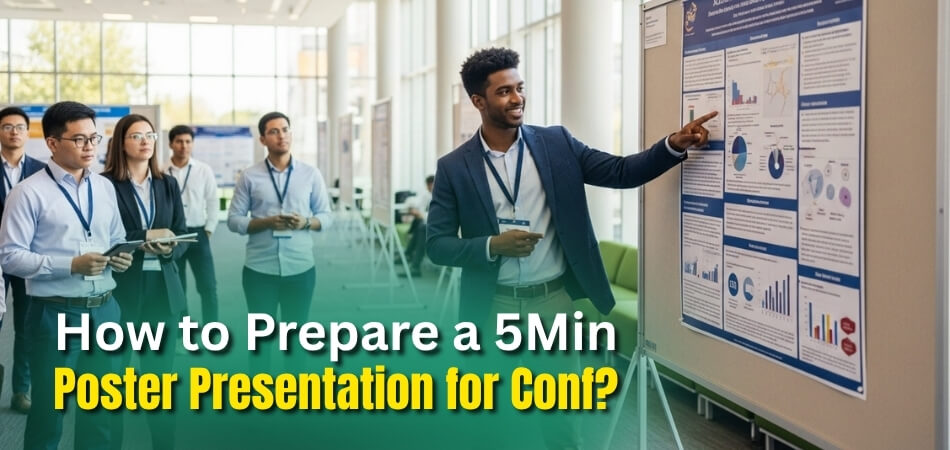
Your poster is your partner, not your script—let it visually emphasize your main points. Move naturally while pointing to relevant sections and explaining them clearly. While designing research posters efficiently for Conference, include visuals that make complex information easy to grasp at a quick glance.
Step 5: Practice Timing and Delivery
Rehearse your presentation multiple times until you can smoothly finish within five minutes. Adjust pacing where you feel rushed or uncertain. Practicing regularly improves your confidence, helps you control your tone, and ensures that every sentence supports your main point effectively.
Step 6: Engage the Audience Actively
Ask short questions or encourage quick thoughts to involve listeners during your explanation. Interaction creates a friendly atmosphere and allows you to connect personally with others. When you invite responses, it shows confidence and can spark meaningful discussions after your presentation ends.
Step 7: End With Clarity and Confidence
Conclude by summarizing your findings in one short, strong statement that leaves a lasting impression. Express appreciation for your audience’s attention and provide a way to contact you afterward. Ending confidently reinforces professionalism and helps others remember both your research and your presentation style.
Best Format for Short Conference Presentation
Delivering a short conference presentation requires focus, flow, and clarity. You have only a few minutes to impress your audience, so every word and slide must count. The right format helps you stay structured and confident. Here are the best formats that make your short presentation powerful and memorable.
- Quick Introduction: Start with your name, title, and the main purpose of your research before giving background context. Keep the tone warm and engaging throughout to connect quickly with your listeners.
- Strong Opening Slide: Use one simple, visual slide that highlights your research question or main idea in a clear, readable design. A bold headline and one image grab instant attention and create curiosity.
- Focused Problem Statement: Clearly define what issue your research tackles and why it matters within your field. Keep the explanation tight, avoiding unnecessary academic terms that may confuse non-experts.
- Concise Method Section: Describe your approach in two or three points that explain how you explored your question effectively. Use diagrams or flowcharts instead of long sentences to make understanding effortless.
- Key Findings Slide: Show your most important results with one or two visuals that tell the story at a glance. Speak about trends and outcomes instead of listing raw numbers or lengthy data.
- Short Discussion: Interpret your findings briefly, focusing on what they reveal and why they matter in broader terms. Link your results to real-world relevance that the audience can easily relate to.
- Clear Conclusion: End with one slide summarizing your main takeaway in simple, memorable words. Reinforce how your work contributes to future research, collaboration, or understanding.
- Audience Interaction: Invite one or two questions to encourage a short but thoughtful discussion after your final slide. Keeping engagement natural leaves a friendly impression and builds useful connections.
Do’s and Don’ts of 5 Minutes Poster Presentation for Conference
A 5 minutes poster presentation for conference can be a turning point if done right — it’s your moment to share big ideas in a short time. But even the most experienced presenters can slip up under pressure. Understanding these do’s and don’ts will help you stay confident, clear, and unforgettable during your presentation.

Do’s: What You Should Always Do
- Start With a Strong Opener: Begin with an interesting fact, short question, or a quick story that grabs attention instantly. A confident opening helps people tune in and stay engaged throughout your talk.
- Keep Your Message Simple: Focus on one main takeaway that summarizes your research clearly. Too many points can overwhelm your audience and weaken your message.
- Use the Poster as a Visual Guide: Let your visuals lead the explanation rather than repeating what’s written. Point at graphs, charts, or key images to make complex details easy to follow.
- Practice Timing Until Perfect: Rehearse your presentation multiple times until you can deliver it comfortably within five minutes. Consistent practice helps control pacing and reduces nervousness on the day.
- Engage the Audience Actively: Ask quick questions or invite short comments while explaining key points. Interaction makes your session more dynamic and helps you connect personally with attendees.
- Design for Readability: Use large fonts, bold headings, and clean layouts that attract attention even from a distance. Good design matters, especially when designing research posters efficiently for Conference settings where visuals compete for attention.
- End with Confidence: Finish with a clear summary and a friendly invitation for follow-up questions or networking. A strong ending leaves a lasting professional impression.
Don’ts: Common Mistakes to Avoid
- Don’t Read Directly From the Poster: Reading word-for-word makes your delivery dull and disengaging. Speak naturally using the poster as a visual reference, not a script.
- Don’t Overload with Text: Posters packed with paragraphs and dense wording lose attention quickly. Use concise points and let visuals communicate most of your information.
- Don’t Ignore the Audience: Avoid talking only to your poster or notes. Make eye contact, smile, and respond to your audience’s reactions as you speak.
- Don’t Speak Too Fast: Rushing through your content can confuse listeners and reduce clarity. Control your pace so every key point lands effectively.
- Don’t Use Complicated Jargon: Unfamiliar terms alienate non-specialist attendees. Choose clear, relatable words that anyone can understand without losing meaning.
- Don’t Forget to Prepare for Questions: Unprepared answers can make you seem unsure about your research. Review possible questions in advance and keep responses short but informative.
- Don’t Skip Your Closing Statement: Ending abruptly without summarizing weakens your message. Always close by restating your main idea and thanking your audience sincerely.
Mastering the do’s and don’ts of a 5 minutes poster presentation for conference takes awareness, confidence, and genuine communication. While preparing for poster presentation at conference, focus on how your visuals and words work together to engage your audience naturally. When clarity, connection, and good design align, your short talk leaves a powerful, lasting impression.
Frequently Asked Questions About 5 Minute Poster Presentation for Conference
A 5 minute poster presentation for conference is a quick yet impactful way to share your research with peers and professionals. It combines visuals, storytelling, and confident delivery. Below are five fresh FAQs that cover what you need to know to stand out effectively.
How Do I Choose the Right Poster Layout for a 5-Minute Presentation?
Select a clean, balanced layout that highlights your title, visuals, and conclusions without clutter. Use columns or sections to guide the audience’s eyes naturally. Ensure your visuals support your explanation, making it easy for attendees to grasp your key points quickly.
What Kind of Visuals Work Best for a 5-Minute Poster Talk?
Use high-quality images, clear graphs, and short text boxes that summarize your main data. Avoid overly complex visuals or crowded slides. Color contrast, icons, and bold headings draw attention and make your content visually appealing and easier to understand.
How Can I Handle Audience Questions During a Poster Session?
Listen carefully and respond briefly with confidence and enthusiasm. If a question requires detail, offer to discuss it after your talk. Engaging politely and showing interest helps build credibility and creates meaningful networking opportunities during the session.
How Should I Dress for a Poster Presentation at a Conference?
Dress professionally but comfortably, choosing smart casual or formal attire depending on the conference setting. Your outfit should help you feel confident, approachable, and camera-ready if photos are taken. Avoid anything distracting so the focus stays on your research.
How Early Should I Arrive Before Presenting My Poster?
Arrive at least 20–30 minutes early to set up your poster, check materials, and get comfortable with the space. Early preparation helps you relax, observe other presenters, and ensure your visuals display correctly before your audience arrives.
Last Words
Sharing your research in five minutes can feel hard at first, but with practice, it gets easier and more fun. Each part—from planning your talk to speaking with confidence—helps you improve your communication skills.
A 5 minute poster presentation for Conference is not only about showing your data; it’s about sharing ideas clearly and connecting with others. When you stay simple, friendly, and focused, your audience will remember your message. Keep practicing, learn from each event, and enjoy every chance to present your work with confidence and excitement.